

Bamboo, Rattan, or Vine?
Compare the shape and thickness of plant strips in a working weave, a porcelain cup, and a rattan bag.
By BeenEast Editorial · Published · Reviewed
Look at the strip before the pattern
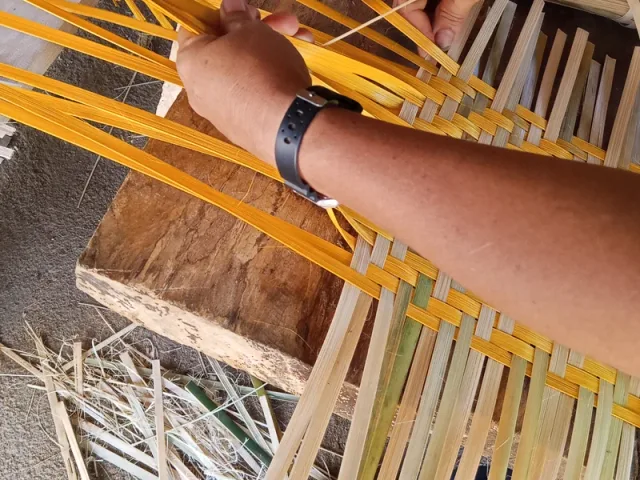
In the working photograph, pale and orange flat strips cross in a loose grid. Look at the broad faces and the thin edges. A strip shows a different profile depending on which side you see. The colors alone do not tell you whether a strip came from the outer or inner layer of the bamboo culm wall. A study of Moso bamboo found that density varies through the culm wall. That result describes the bamboo studied and does not establish the strength of every weaving strip.
Sources: Dixon and Gibson · The structure and mechanics of Moso bamboo · MaxixKatana · Original photograph (cropped here) · CC BY-SA 4.0 · Photo license (also applies to the crop)

Follow fine strips around a porcelain cup
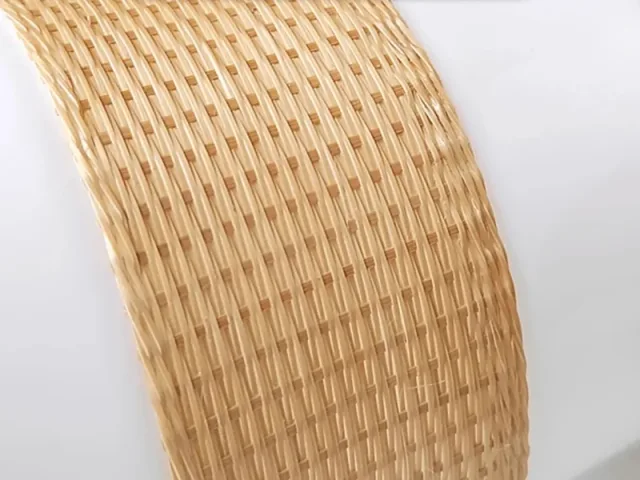
Follow the edge of the narrow woven band as it curves around the white cup. The close view lets you compare the fine rows with the uninterrupted porcelain next to them. The two cups in the catalog have lighter and darker woven bands. Their appearance does not tell us how each was colored. The Qionglai heritage record describes fine strips of cizhu bamboo fitted to porcelain and records heat coloring and dyeing among its techniques.
Sources: China Intangible Cultural Heritage · Qionglai porcelain-body bamboo weaving · BeenEast · Porcelain cups with woven bamboo bands
Compare labeled rattan and vine pieces
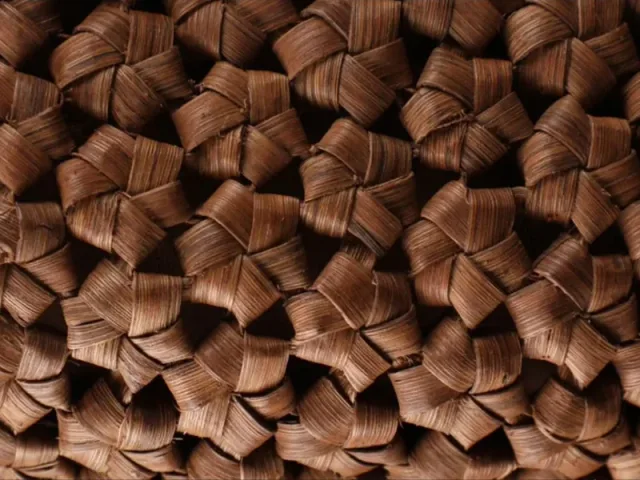
On the Hexa Blossom rattan bag, folds in the strips build up a raised flower knot. On the catalog’s Sunset Basket grapevine bag, look instead at the flatter strips forming the wall. The labels identify the two materials. The photos let you compare the profile and thickness of the strips in these examples. The Anxi heritage record documents bamboo and rattan weaving in a named tradition. Use the maker’s material description when you need to distinguish species or treatments.
Sources: BeenEast · Hexa Blossom handwoven rattan handbag · BeenEast · Sunset Basket handwoven grapevine handbag · China Intangible Cultural Heritage · Anxi bamboo and rattan weaving (VII-51)
Continue reading
References
Dixon and Gibson · The structure and mechanics of Moso bamboo
China Intangible Cultural Heritage · Qionglai porcelain-body bamboo weaving
China Intangible Cultural Heritage · Anxi bamboo and rattan weaving (VII-51)
BeenEast · Porcelain cups with woven bamboo bands
BeenEast · Hexa Blossom handwoven rattan handbag
BeenEast · Sunset Basket handwoven grapevine handbag