

How to Read Plain, Twill, and Hexagonal Weaves
Follow individual bamboo strips to see how alternating crossings, staggered rows, and three crossing directions make three different weaves.
By BeenEast Editorial · Published · Reviewed
Plain weave changes at every crossing
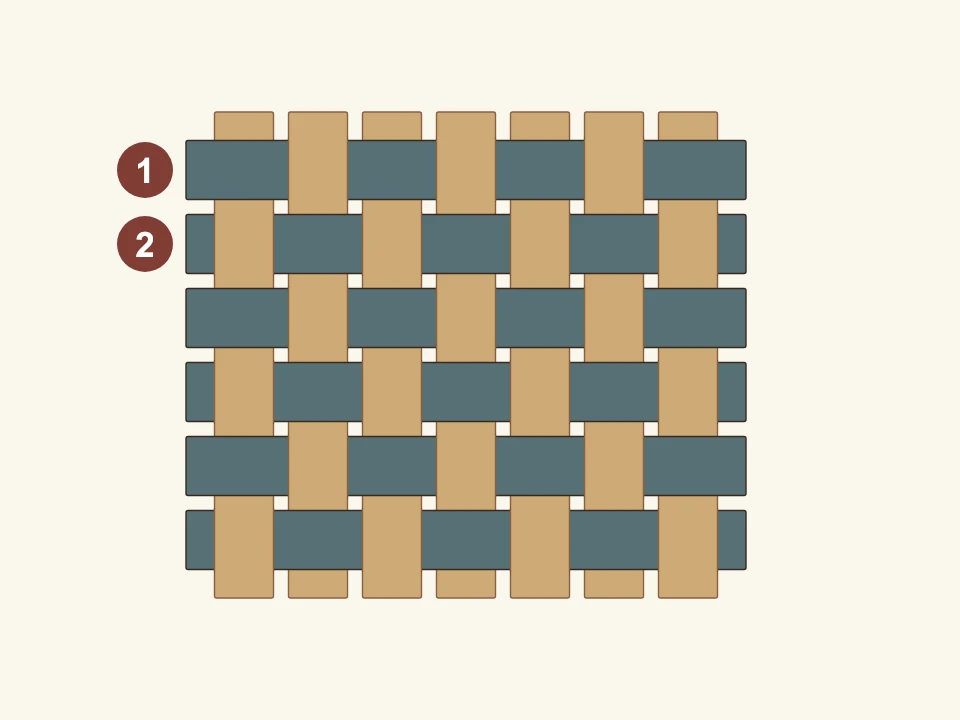
Plain weave alternates over and under at every crossing. In a simple twill, a strip passes over several strips at a time, and the next row shifts those longer passes to form a diagonal. Hexagonal open weave uses three sets of strips running in different directions. The six-sided openings sit between those sets. Follow the strips from one crossing to the next to tell the patterns apart, even when the bamboo is all one color.
On a flat panel viewed from above, one set of strips runs from top to bottom. A strip running across the panel covers the first of those strips, disappears beneath the next, and comes back up over the third. Its neighbor starts on the opposite side of that first strip. On the face of the panel, that puts an exposed cross strip beside a hidden one in both directions. The result is a checkerboard of crossings, even on a panel with no change in color.
At the October 2018 China Academy of Art Folk Art Museum workshop in Hangzhou, the introductory sequence began with this one-over, one-under action before moving to longer passes. The same museum handout shows how changing the crossing count changes what the eye sees on the surface.
Twill makes a diagonal out of staggered rows
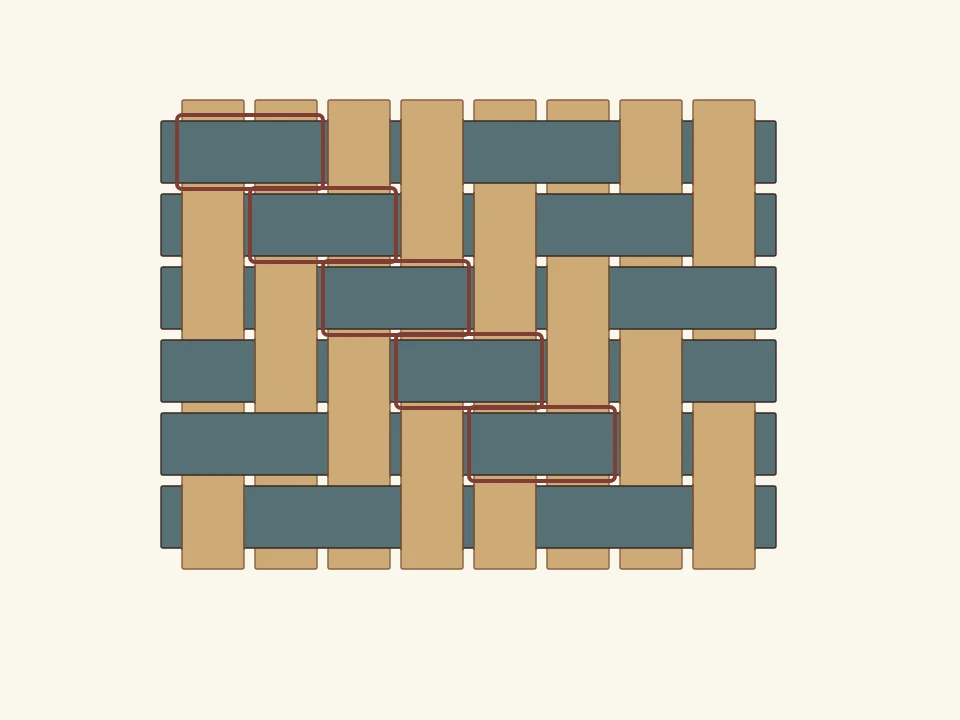
In a two-over, two-under twill, a strip stays visible across two crossings before it goes beneath the next two. The visible length is called a float. If the float in each successive row begins one crossing farther along, its ends line up in steps. Those steps read as a diagonal even though the strips in this example still cross at right angles. Reversing the direction of the steps can create a herringbone. Other twills use different crossing counts.
The museum's workshop handout describes a two-over, two-under herringbone panel. In a separate recorded demonstration, bamboo artisan Tsai Hui-ting uses three over and three under. Both use longer floats than plain weave. The number of crossings under each float distinguishes these examples more reliably than the color or slope of a stripe.
Hexagonal weave leaves openings between three directions
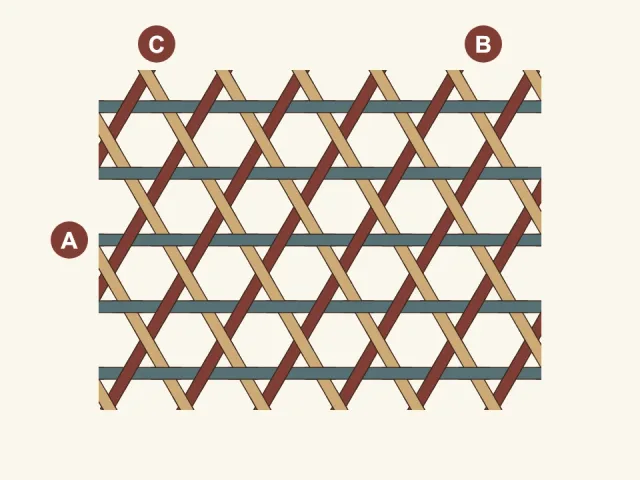
In Shih Chih-cheng's bamboo weaving demonstration, three families of strips form a lattice. On a flat section, one family can appear nearly horizontal, with the other two slanting in opposite directions. A strip on one side of an opening continues past the corner into the next part of the weave. The strips cross around repeating six-sided openings, with smaller triangular spaces between them. The crossings hold the three directions together, so reading only the outline of a hole misses how the lattice is connected.
Openings can look narrower around a curve or in an angled photograph. A square-on view of the same area makes it easier to follow a strip through two or three crossings. If you can see a diagonal but count only two strip directions, check for staggered floats. If you can follow strips in three directions around the opening, you have evidence of the structure shown in Shih's example.
Continue reading
References
China Academy of Art Folk Art Museum, bamboo weaving workshop handout
National Cultural Memory Bank, Tsai Hui-ting's twill demonstration
Taiwan Bamboo Society, Shih Chih-cheng's bamboo weaving demonstration