

What Is Cloisonné Jewelry? A Guide to Buying Vintage Pieces
See how metal strips shape the colors, then check a vintage piece’s age, fit, and condition before you buy.
By BeenEast Editorial · Published · Reviewed
What the lines between colors do
Cloisonné jewelry uses thin metal strips set on edge to divide a design into small cells. The maker fills the cells with colored glass enamel and fires it so the glass fuses. When the surface is finished, the narrow tops of the strips can remain visible as part of the design. Start with the red-and-black bangle from a contemporary Chinese workshop. Follow one metal line around a red shape. The side of that strip held the enamel in the cell, and its top now draws the outline you see.
Sources: The Met · Chinese Cloisonné technique
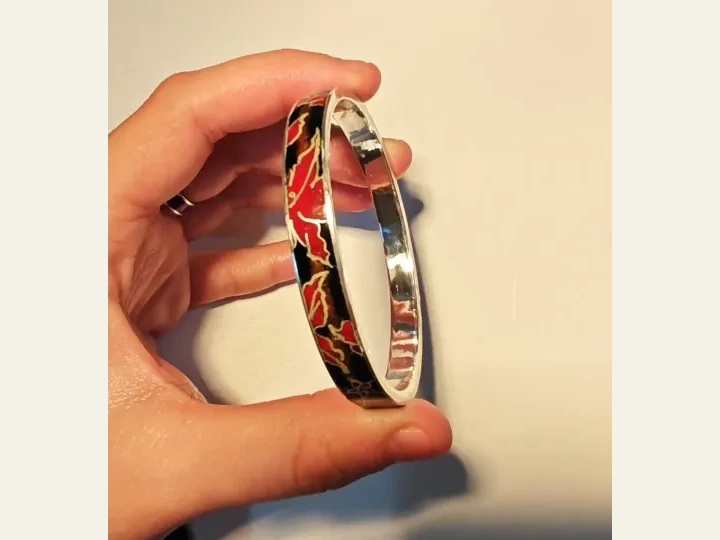
Color boundaries help you decide what to inspect next. A bright line can also be painted, cast into the base, or used to contain a resin fill. If an online listing has only one polished front view, look for a record that names both the partitions and the fired glass, or ask how the piece was made.
Compare how the patterns are made
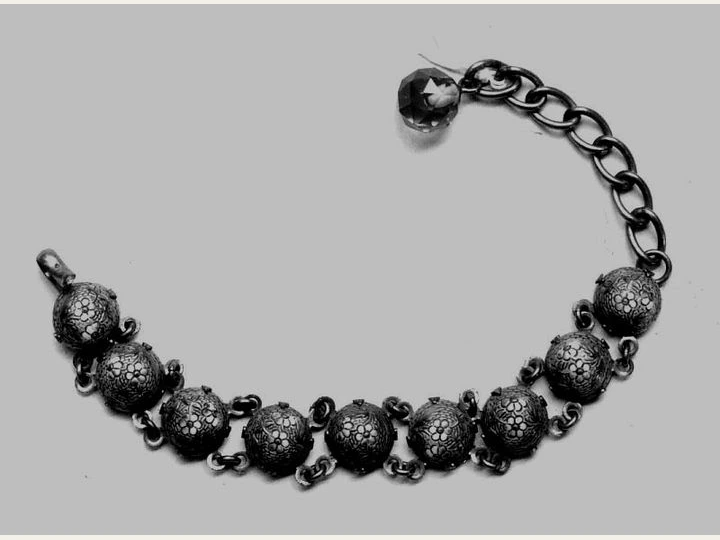
The Met catalogs this nineteenth-century Chinese bracelet as painted enamel beads. See how the patterns follow the rounded beads and how the beads connect to a chain. Painted enamel can carry detailed color on each bead’s surface. In cloisonné, added metal strips form small walls between fills. Both are ways to decorate jewelry with enamel, and the difference is how the pattern is built.
Sources: The Met · Chinese painted enamel bead bracelet
What “vintage” tells you
Treat “vintage” as the seller’s statement about age and check what supports it. Start with the Chinese metal-and-enamel bracelet in the Smithsonian’s National Museum of Asian Art. The museum classifies it as cloisonné, lists the Republican period in its catalog, and says research into its ownership history is ongoing. For comparison, the Met dates the French bangle below to about 1875 and records its medium as gold and cloisonné enamel. The entry names two possible makers, Alexis or Lucien Falize. Both records show how dates, materials, and ownership can have different levels of documentation.
Sources: The Met · Falize bangle bracelet · Smithsonian National Museum of Asian Art · Chinese cloisonné bracelet
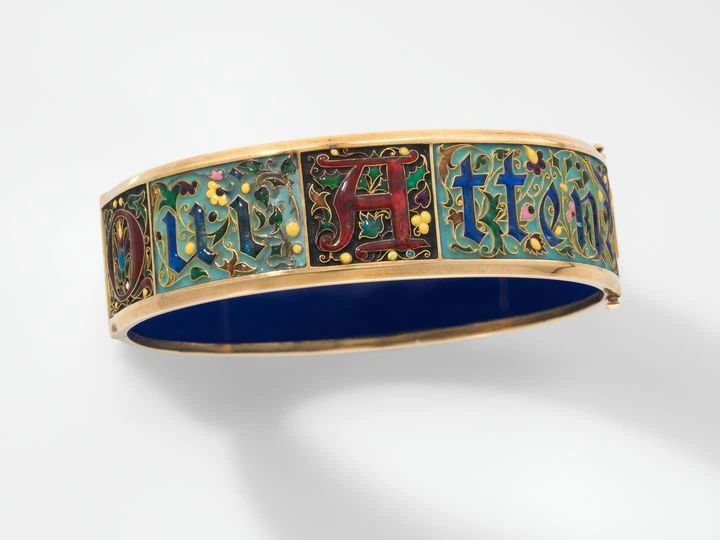
For a claimed decade or maker, ask for a clear photo of any mark and the record behind the date, such as an original receipt, a dated catalog, or a documented ownership history that matches the piece. A mark is a lead to check. A floral pattern, gold-colored line, or darkened metal alone gives you little basis for assigning a date or country.
Check the opening and the hardware
For a rigid bangle that slips over the hand, measure the opening of a similar bangle you can already put on comfortably. Compare the inside width at the widest point and the inside height across it, with both bangles in the same orientation. A 60 × 54 mm opening (about 2.36 × 2.13 in.) and a 62 × 50 mm opening (about 2.44 × 1.97 in.) are hypothetical examples. The second is 2 mm wider and 4 mm shorter across the other axis, so the larger width by itself gives you little assurance. Ask whether the opening is round or oval if the listing gives only one number.
A hinged bangle opens around the wrist. Check the closed inside size and ask for a photo of the hinge and latch in the open and closed positions. With a brooch, ask whether the pin lies straight and catches securely. A clasp that opens unexpectedly can make a piece unsuitable for regular wear even when the enamel looks intact.
Check the rim, back, and wear points
Ask for the front, reverse, inside or edge, and any damage in angled light. A worn patch on the inside may matter mostly to appearance if the surface is smooth and stable. A sharp chip at a rim can catch fabric or rub the skin. Loose enamel, a crack near a hinge, or a poorly documented repair deserves a closer look before you plan to wear the piece. A photo can show where to look, but it cannot show whether an edge moves.
Sources: Canadian Conservation Institute · Glass and ceramic care
The red-and-black bangle makes the distinction easy to see. Its outer surface carries the color and fine outlines. Its inner curve and two rims are what your hand passes through and what your wrist meets as you wear it.
Continue reading
References
The Met · Chinese Cloisonné technique
The Met · Chinese painted enamel bead bracelet
The Met · Falize bangle bracelet
Smithsonian National Museum of Asian Art · Chinese cloisonné bracelet