

Gloss, Texture, and Pattern in Lacquerware
See how reflected light and carved relief shape the look of lacquerware, then compare finishes under the same light.
By BeenEast Editorial · Published · Reviewed
What a highlight tells you
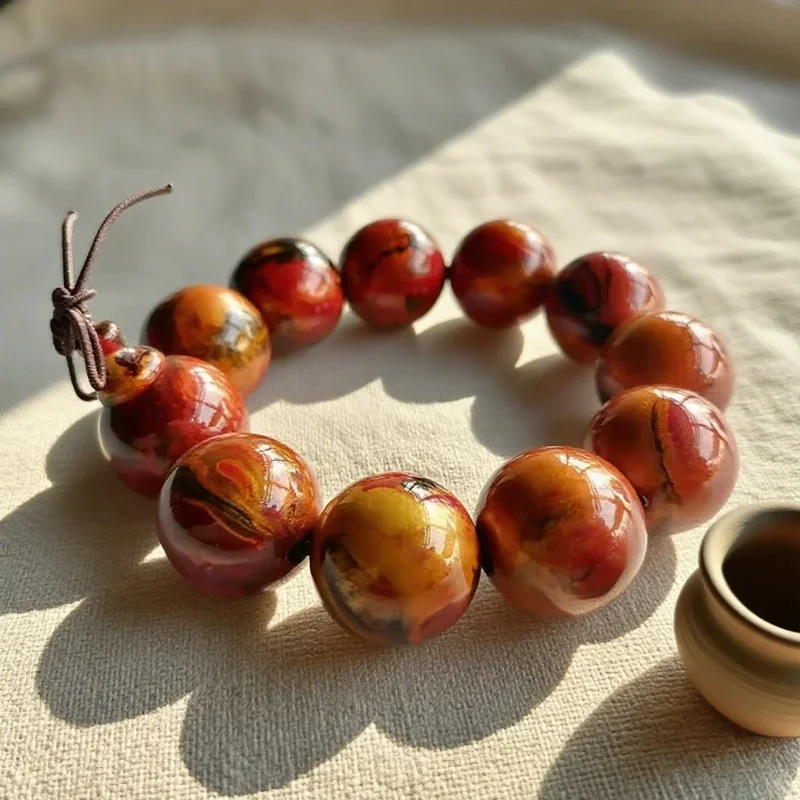
Gloss describes how distinctly a surface reflects light. Texture describes its physical relief, from fine grain to deep grooves. A lacquer surface can have both: a smooth ridge may catch a sharp highlight even when it borders a carved recess. Color and pattern are another part of what you see.
Small white highlights cross the amber and red bands as the curved beads catch the light.
How carved relief changes the surface
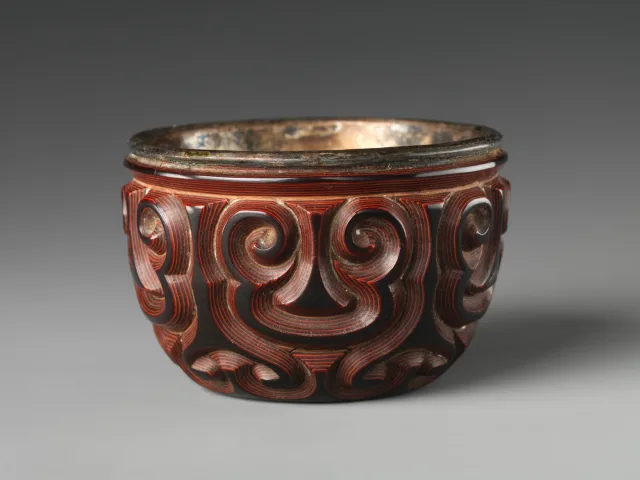
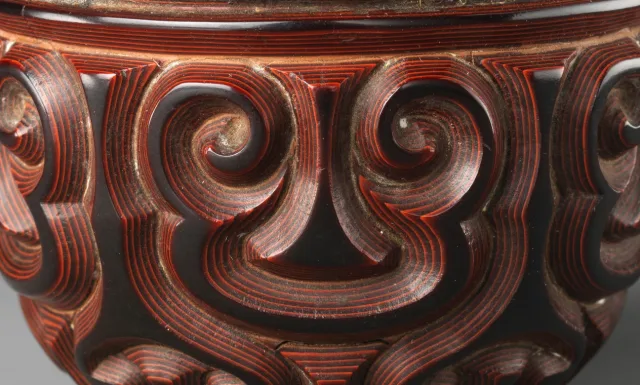
On the Met’s Yuan dynasty guri lacquer cup, dark scrolls repeat around the wall below the rim. The close view shows narrow red bands along the sides of the grooves. The Met identifies the medium as black lacquer carved through red layers. As the cut slopes through the built-up lacquer, it exposes thin bands of red along the groove.
Sources: The Met — Guri lacquer cup
How to compare sheen fairly
Compare similarly shaped areas under the same light. A small lamp can make a tight highlight, while a broad window can produce a wide reflection. On a curved wall, the highlight also moves as you turn the piece. The shape of a bright patch in two unrelated photos tells you little about which finish is glossier.
At a shop, place the pieces near the same light and compare flat areas with flat areas or curved walls with similar curves. Online, a second view of the same area can help: a bright patch that shifts with the angle is a reflection, while the outline of a carved groove stays in the same place on the object.
What a localized mark can tell you
The repeated grooves on the guri cup belong to its design, as the museum record confirms. An isolated cloudy patch or raised edge on another piece calls for a closer view and a condition description. A photograph can locate the change. Its cause depends on the object and its history.
What you see at different distances
At arm’s length, you see a band of dark scrolls below the rim. Up close, fine red lines trace the sides of each groove.