

How to Look at Lacquerware: Shape, Surface and Detail
See how a lacquer box’s shape, shell inlay, and dark ground work together through two views and a close detail.
By BeenEast Editorial · Published · Reviewed
The box in two views
Looking closely at lacquerware means connecting its shape, decoration, and surface. Two views of the same object reveal different parts of that relationship: an angled photograph shows how the lid meets the body, while a view from above makes the pattern easier to follow.
This Korean stationery box dates to the fifteenth or sixteenth century. The Met describes boxes like it as containers for paper and writing implements. Its broad lid offers a large field for decoration; in the angled view, a narrow seam separates that lid from the shallow body below.
Sources: The Met — Stationery box decorated with peony scrolls
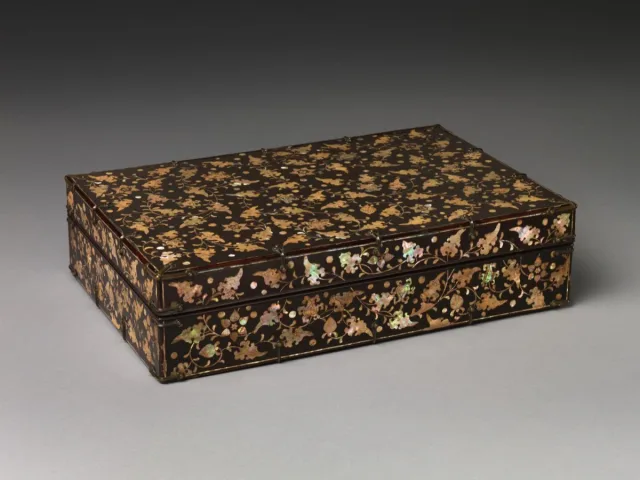
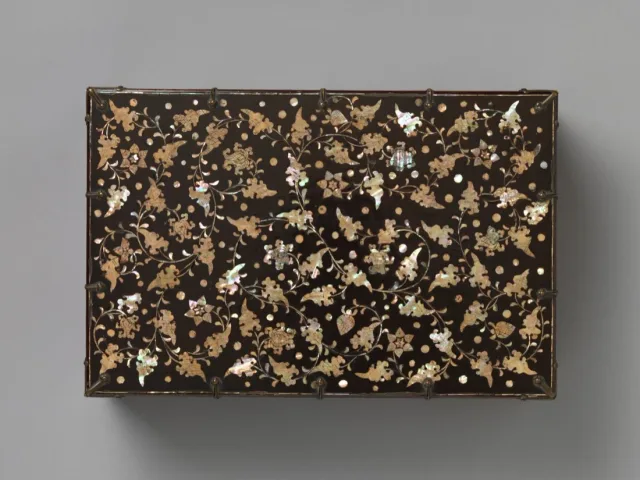
The metal fitting at the near-left corner links the two views. From above, the lid reads as a rectangle filled with ornament. At an angle, the decorated front comes into view beneath it. The same pale-on-dark contrast appears on both surfaces, while the seam keeps their separate edges visible.
Flowers, stems, and the dark ground
The lid’s design combines broad, lobed leaves, rounded peony blossoms, fine curling stems, and scattered dots. The larger shapes catch the eye first. Narrow stems lead from one cluster to another, making the ornament read as connected growth across the lid.
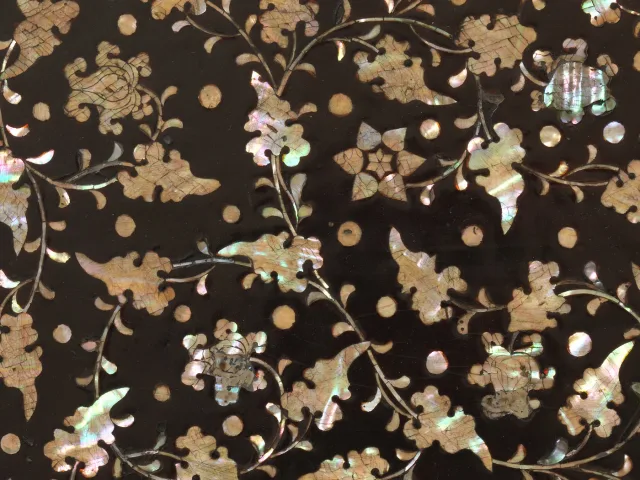
In this detail, the curved stems remain visible because dark space surrounds them. That dark background—often called the ground—also separates neighboring leaves and flowers. Small round dots occupy some of the gaps without joining the stems. Distinguishing these shapes makes a dense design easier to follow: the stems connect it, while the ground keeps its parts legible.
What the surface reveals
The pale shapes vary from warm cream to pink and green highlights. The Met identifies the decoration as mother-of-pearl inlay and the fittings as brass. Mother-of-pearl is the lustrous inner layer of shell; inlay places shaped pieces into a surrounding surface. Here, the shell supplies the light ornament against the dark lacquer.
Sources: The Met — Stationery box decorated with peony scrolls · The Met — Mother-of-Pearl: A Tradition in Asian Lacquer
The detail photograph shows both broad shell shapes and slender lines. In its account of the craft, the Met describes shell being cut, trimmed, and polished into the desired shapes before it is inlaid into lacquer. That makes the outline of each element part of the material work: a fine curling line and a broad leaf call for differently shaped pieces.
Sources: The Met — Mother-of-Pearl: A Tradition in Asian Lacquer
The photographs were taken from different angles and under different lighting, so a brighter patch alone cannot establish wear or a change of material. They also leave the depth of the inlay and the layers beneath it unseen. A close photograph helps describe an edge; a technical account is needed to explain the hidden construction.
Putting the observations together
A description of this box can now connect its parts: a broad rectangular lid sits above a shallow body; curling stems link flowers and leaves across the lid, with dark gaps separating their outlines; shell inlay provides the pale, shifting color identified in the museum record.
For another piece, those relationships offer a useful starting point. A side view can clarify an edge or joint that disappears from above. A detail can reveal how a line meets its background. The object record can then name the material or technique, giving the visible evidence a more precise explanation.