

How Does Pingyao Lacquerware Get Its Gloss?
Follow the layers beneath the finish, see how Pingyao makers polish lacquer by hand, and learn to distinguish surface gloss from decoration.
By BeenEast Editorial · Published · Reviewed
What tuiguang means
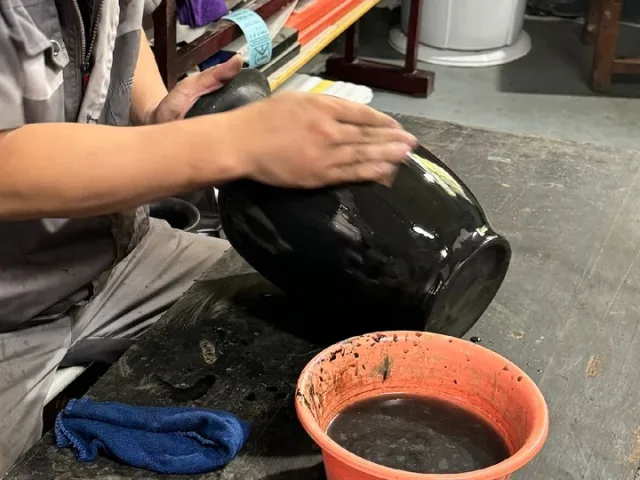
Pingyao lacquerware gets its gloss through successive rounds of smoothing and fine polishing. After a lacquer coat cures, makers can sand it smooth. For the final polish, they rub the prepared surface with the palm and a fine abrasive to bring up a clearer shine. The name tuiguang refers to this final hand polishing. This tradition from Pingyao, in China’s Shanxi province, entered the country’s first national list of intangible cultural heritage in 2006.
Sources: China’s national heritage register — Pingyao lacquerware
China’s heritage register describes Pingyao lacquerware as already well known in the eighth century and records its growth alongside Shanxi merchants in the Ming and Qing dynasties. Local makers used the techniques on everyday objects such as chests and tea tables as well as decorative screens and lacquer paintings.
Sources: China’s national heritage register — Pingyao lacquerware
The finish starts beneath the lacquer
Natural lacquer comes from the sap of the lacquer tree. In traditional Pingyao lacquerware with a wooden core, the wood gives the object its shape. Makers may cover it with cloth and level it with a paste called a ground. The ground fills small depressions so the lacquer has an even surface to sit on. Thin coats cure in a sheltered chamber before makers work on the surface again.
Sources: China’s national heritage register — Pingyao lacquerware · The Met — Lacquerware of East Asia
In an interview at his workshop, Xue Shengjin described wet-sanding each cured coat before preparing it for another coat. Building the surface in thin coats gives the maker a chance to smooth irregularities at each round and lay the next coat over an even surface.
Sources: People’s Daily — Xue Shengjin’s workshop, the Ladies box, and contemporary Pingyao lacquerware
What the palm does
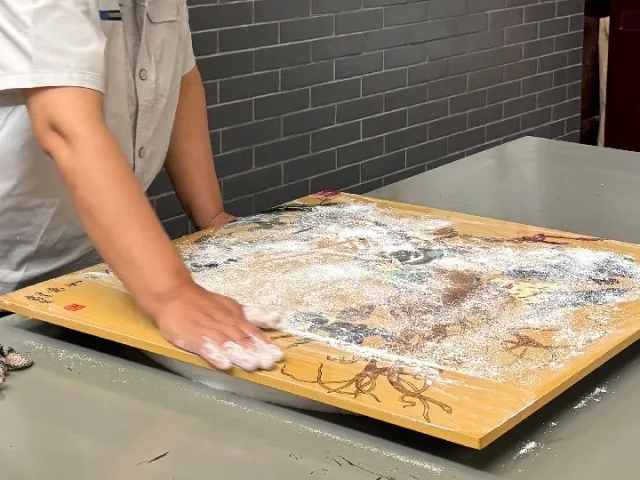
Pingyao polisher Wang Hailian described leveling the final coat with fine sandpaper and strands of hair. She then applied soybean oil and fine brick powder and rubbed the surface with her palm. The brick powder is the fine abrasive in her last pass. Her palm carries it across the leveled lacquer so it can smooth the tiny marks left by sanding. The heritage register also lists charcoal, hair, brick powder, and sesame oil among the materials used in the tradition. Wang’s account shows how one workshop puts some of those materials to work.
Sources: China Culture Daily — Workshop interview with Wang Hailian · China’s national heritage register — Pingyao lacquerware
A rougher surface spreads reflected light in more directions. A smoother one can return a more sharply defined highlight from the same light source. Leveling and fine polishing work together to produce the reflections you see on a finished piece.
Sources: Tominaga and Doi — Study of surface roughness and gloss
Read the reflection and the design separately
Painting and gilding create lines and colors on the lacquer. Some techniques also give the design relief. Xue Shengjin described building up lacquer to raise buildings and rocks above the surrounding surface, then applying gold to those raised forms. A peony jewelry box documented in China’s intangible heritage exhibition uses another approach. Pieces of mother-of-pearl form the floral design. These are ways to compose a picture on the surface. Palm polishing shapes how the surface reflects light.
Sources: CCTV — Xue Shengjin demonstrates raised lacquer decoration · China Intangible Cultural Heritage Digital Museum — Pingyao lacquerware exhibition
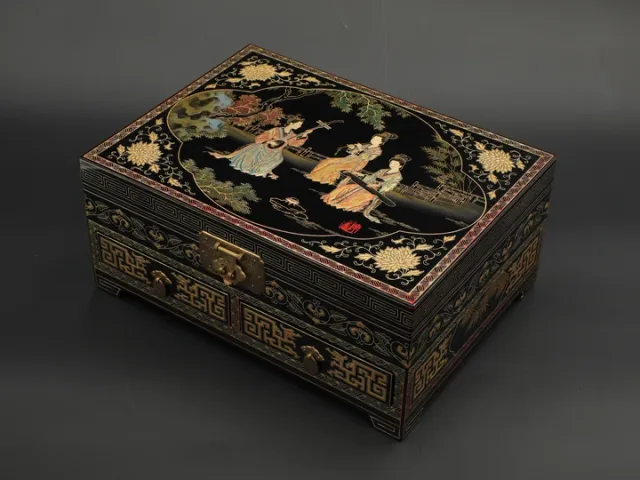
On Xue Shengjin’s Ladies lacquer box, painted figures sit against a dark field on the lid. The photograph lets you trace the outlines of the figures and the open areas around them. With a lacquer object you can safely reposition, change your viewing angle near a window. The highlight will travel across the surface while the design stays in place. On a nearly flat area, a more defined highlight shows that the reflection is more concentrated. This helps you read the finish. To learn what coating the maker used or how it was polished, look for a record of the individual piece.
Sources: People’s Daily — Xue Shengjin’s workshop, the Ladies box, and contemporary Pingyao lacquerware · Tominaga and Doi — Study of surface roughness and gloss
How makers carry the tradition forward
Xue Shengjin joined the Pingyao lacquerware factory in 1958 and studied with Qiao Quanyu. He later revived the technique of building raised designs in lacquer and taught apprentices in his workshop. That revival gave makers a way to shape features such as buildings and rocks in lacquer relief.
Sources: China’s national heritage practitioner record — Xue Shengjin · People’s Daily — Xue Shengjin’s workshop, the Ladies box, and contemporary Pingyao lacquerware
The same local tradition also has smaller forms designed for everyday use. Designer Hu Xiaoming made a ring-shaped storage box with gilded zodiac animals on a smooth black or colored surface. Set it beside the Ladies box in your mind. The shape and subject change, while the lacquer surface still carries both a shine and a design.
Sources: People’s Daily — Xue Shengjin’s workshop, the Ladies box, and contemporary Pingyao lacquerware
Continue reading
BeenEast Editorial checked China’s national heritage register, maker interviews, and research on surface gloss. The two workshop photographs show separate pieces. The finished Ladies box is an independent example.
References
China’s national heritage register — Pingyao lacquerware
The Met — Lacquerware of East Asia
People’s Daily — Xue Shengjin’s workshop, the Ladies box, and contemporary Pingyao lacquerware
China Culture Daily — Workshop interview with Wang Hailian
Tominaga and Doi — Study of surface roughness and gloss
CCTV — Xue Shengjin demonstrates raised lacquer decoration
China Intangible Cultural Heritage Digital Museum — Pingyao lacquerware exhibition
China’s national heritage practitioner record — Xue Shengjin