

What Is Lacquerware?
Learn what lacquerware is by looking closely at a carved tray, a shell-inlaid box, and a gold-decorated sake vessel.
By BeenEast Editorial · Published · Reviewed
What is traditional lacquerware?
Traditional East Asian lacquerware is made by coating objects with lacquer derived from tree sap. Bowls, trays, boxes, and furniture often have a wooden core that gives them their shape. Their lacquer surface may be colored, carved, or decorated with shell or metal powder.
Sources: The Met — Lacquerware of East Asia: materials and repeated coating
A red tray, a shell-inlaid box, and a gold-decorated sake vessel show how differently makers can work with this material. Each brings a different part of the craft into view, from the depth of a carved scene to the fine lines of a flower.
A garden carved in red lacquer
A garden rock and small figures rise above finely patterned ground on this fourteenth-century Chinese tray. The Met identifies three background patterns for sky, water, and land. Even within a single red surface, the carving gives each part of the scene a distinct texture.
Sources: The Met: Tray with Women and Boys on a Garden Terrace
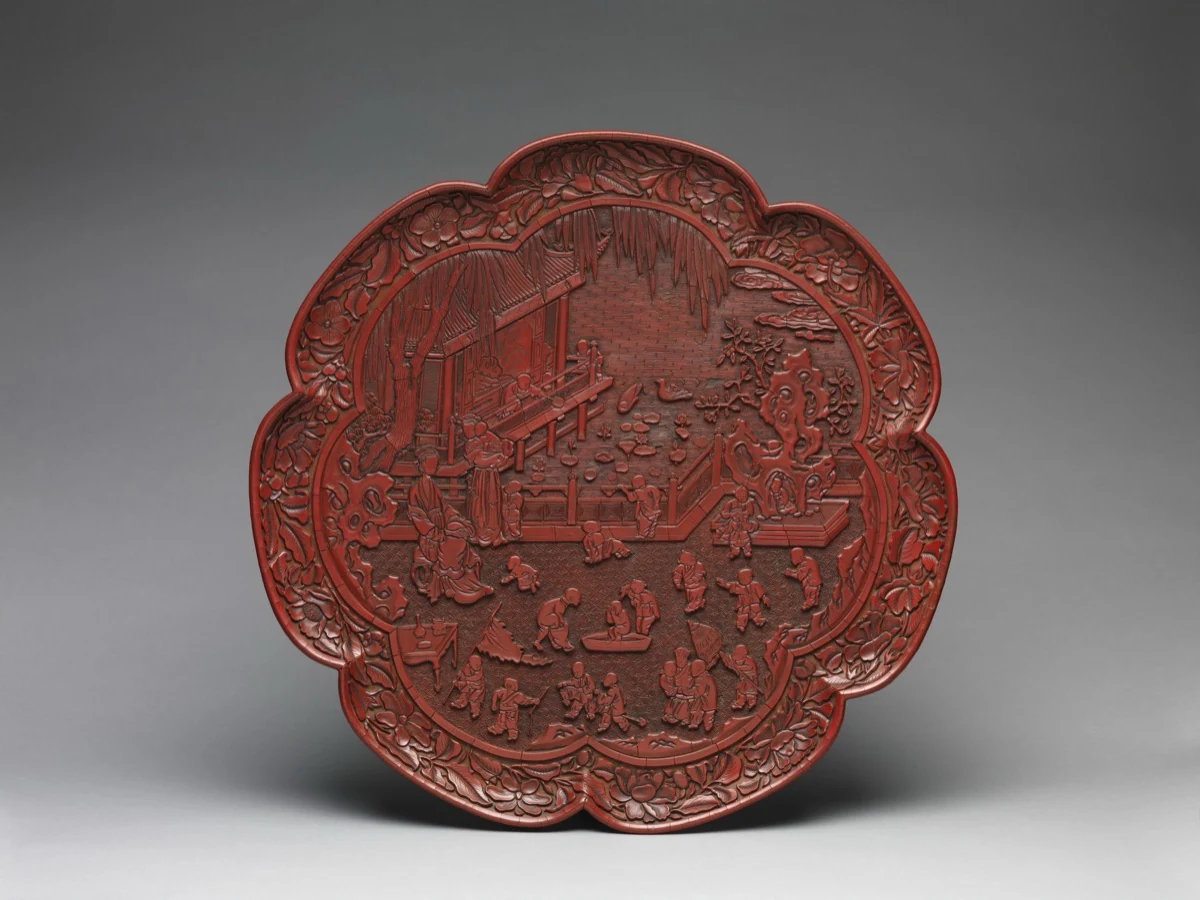
This depth comes from lacquer built up over a supporting body and then carved. Cutting away the background leaves the figures standing higher, an effect called relief. The Met identifies the tray’s surface as carved red lacquer but does not specify the material beneath it.
Sources: The Met — Lacquerware of East Asia: materials and repeated coating · The Met: Tray with Women and Boys on a Garden Terrace
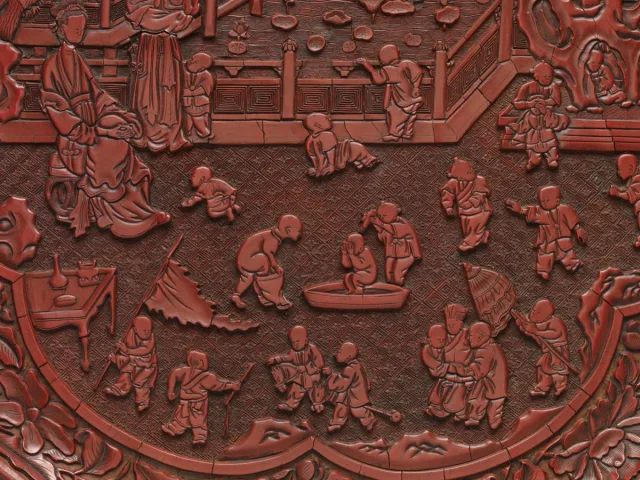
In the close-up, the child’s outline meets a dense diamond pattern. The larger figure and the tiny repeated cuts give the eye two scales of detail to explore.
Sources: The Met: Tray with Women and Boys on a Garden Terrace
Building the lacquer surface
Lacquer gains its thickness one thin coat at a time. Each coat must harden before the next is applied. In a humid cabinet, tree lacquer undergoes a chemical reaction called polymerization that turns the liquid into a solid coating. Urushi is the Japanese name for this lacquer.
Sources: V&A — Urushi conservation: curing chemistry and maki-e · The Met — Lacquerware of East Asia: materials and repeated coating
The repeated coating gives a carver enough material to work into. A bowl with a thin lacquer finish and a deeply carved tray are both lacquerware, but the tray’s decoration depends on a much thicker buildup.
Working with raw lacquer also calls for care because it can irritate the skin. A supervised workshop introduces safe handling and the judgment needed between coats.
Sources: V&A — Urushi conservation: curing chemistry and maki-e
Shell, metal powder, and carved lacquer
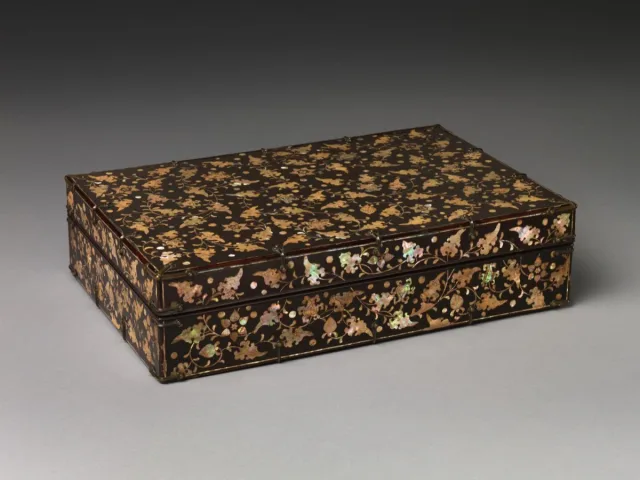
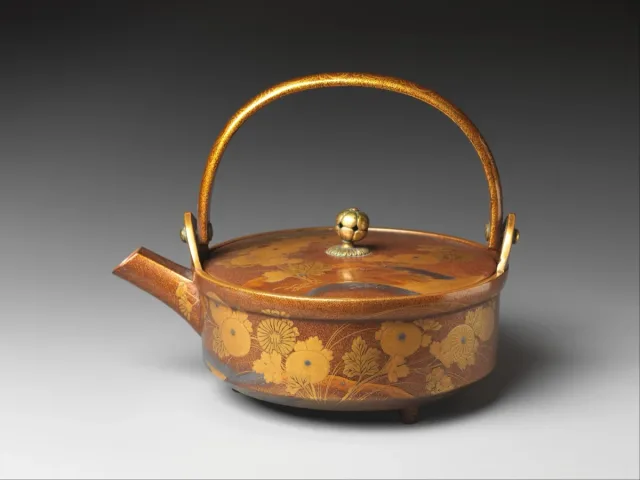
Pale shell peonies stand out against the dark lacquer of the Korean box. On the Japanese sake ewer, a vessel for pouring sake, gold petals and fine leaves spread across the rounded body. The Met identifies these decorations as mother-of-pearl inlay and gold and silver maki-e.
Sources: The Met: Stationery Box Decorated with Peony Scrolls · The Met: Sake Ewer with Decoration of Chrysanthemums on a Stream Bank · The Met: Tray with Women and Boys on a Garden Terrace
| Technique | What the maker does | What makes the design | What you can see |
|---|---|---|---|
| Carved lacquer | Build up lacquer, let it harden, then cut into it. | The lacquer itself forms the relief. | Raised figures stand above the carved background. |
| Mother-of-pearl inlay | Place shaped shell pieces into the lacquer decoration. | Pieces of shell form the pattern. | Shell forms pale, iridescent patterns against the lacquer. |
| Maki-e | Sprinkle metal powder onto wet lacquer to form a design. | Lacquer holds the metal powder in place. | Metal powder forms the decoration, which may be flat or raised. |
On the tray, the ornament is carved into lacquer. On the box and ewer, shell and metal powder become part of its surface. The material connects the three objects. The way each maker decorates it sets them apart.
Sources: The Met: Tray with Women and Boys on a Garden Terrace · The Met: Stationery Box Decorated with Peony Scrolls · The Met: Sake Ewer with Decoration of Chrysanthemums on a Stream Bank
Continue reading
BeenEast Editorial checked the descriptions against museum records. The photographs show the objects discussed and come from The Met Open Access collection.
References
The Met — Lacquerware of East Asia: materials and repeated coating
The Met: Tray with Women and Boys on a Garden Terrace
The Met: Stationery Box Decorated with Peony Scrolls
The Met: Sake Ewer with Decoration of Chrysanthemums on a Stream Bank