

Test Paper with the Scissors You Have
Try the same two cuts on two folded scraps and choose the paper that gives you the openings you want.
By BeenEast Editorial · Published · Reviewed
Set up two comparable samples
Try the same straight-sided opening and shallow curve on two scraps, using one pair of scissors and the same number of folds. Compare how the paper feeds into the blades, whether the edges stay intact, and whether the two halves line up after opening. This small test helps you choose for your own folded pattern; it does not establish that one kind of paper is always better.
Use scraps from the sheets you actually plan to cut. The method below is an editorial practice, not a report of a completed BeenEast paper trial. The actual choice depends on your two samples.
Start with plain printer paper and a second paper you might use for the finished piece, such as lightweight colored craft paper. Keep the wrapper if it lists the paper type or weight. Cut both scraps to the same size and fold each once. Mark them A and B away from the fold so you can tell them apart after opening. Use the same scissors on both. Point the closed fold toward you so you start from the same edge every time.
On each scrap, mark two small shapes along the fold with some space between them. Draw two straight slants that meet at a point for the first and a shallow curve of a similar size for the second. Both ends of each outline meet the fold. Draw both shapes along one straight edge of a spare card and cut the two notches out of that edge. Place this template over each folded scrap, lining up the straight edge of the card with the closed fold, then trace the edges of the notches. You do not need to see through the paper. Leave plenty of paper around the marks so you can compare the cut edges.
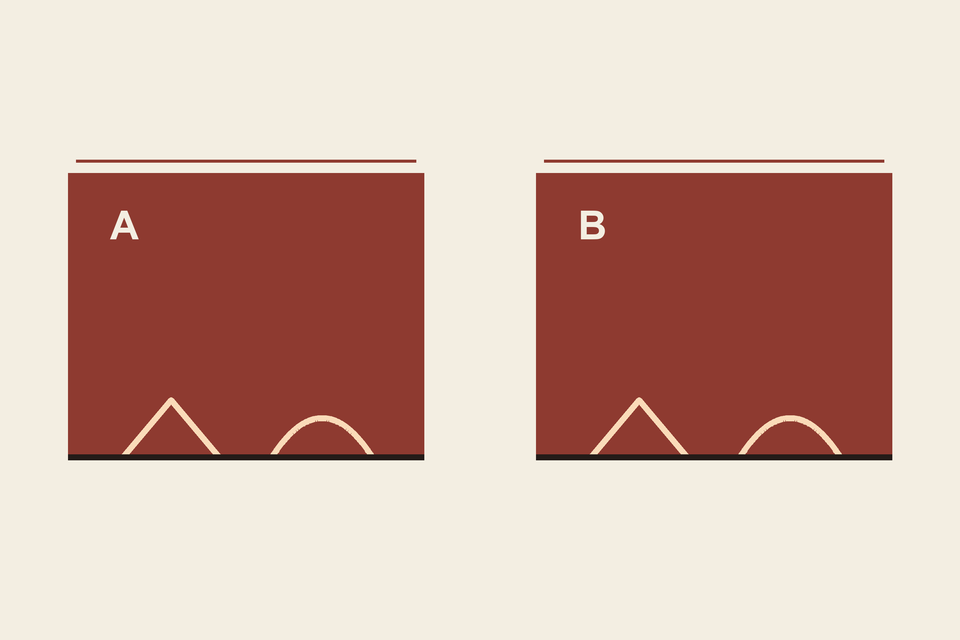
Compare a straight cut and a curve
On A, start at the fold and cut one straight slant to the marked point. Start the other slant at its end on the fold and make it meet the first cut at the point, releasing the small triangle. Repeat on B. Hold the broad part of each folded scrap so both layers stay together, and notice whether the paper moves ahead of the blades instead of being cut. Stop if you have to force the scissors.
Next, cut the shallow curve on A and then B. Begin at one end on the fold, turn the paper as the line bends, and return to the other end of the outline at the fold. Remove the small curved scrap without pulling it. Use short, controlled strokes and the same approach on both samples. The two openings test different demands: the slants give you a straight edge to compare, while the curve requires you to feed and turn the folded paper together.
Open both scraps and set them side by side under the same light. Compare the straight openings first, then the curved ones. Separate the outline from the condition of the edge. Small straight facets change the curve; a split extends beyond that edge into paper you meant to keep. A photo can show those shapes, but it cannot tell you how much force the maker used, so note that while cutting.
The crease remains in the paper at either end of an opening, not across the empty space. Imagine a line joining those two ends and compare how far each half extends from it. Refold along the original crease and compare the corresponding cut edges; also check that both layers were cut through. Record any mismatch you can see. Call it movement during cutting only if you actually saw the layers move.
Uneven halves alone do not prove that the paper is unsuitable. Repeat with the same paper and better support. If you change the support or cutting approach and want to compare materials again, repeat both papers under those same new conditions.
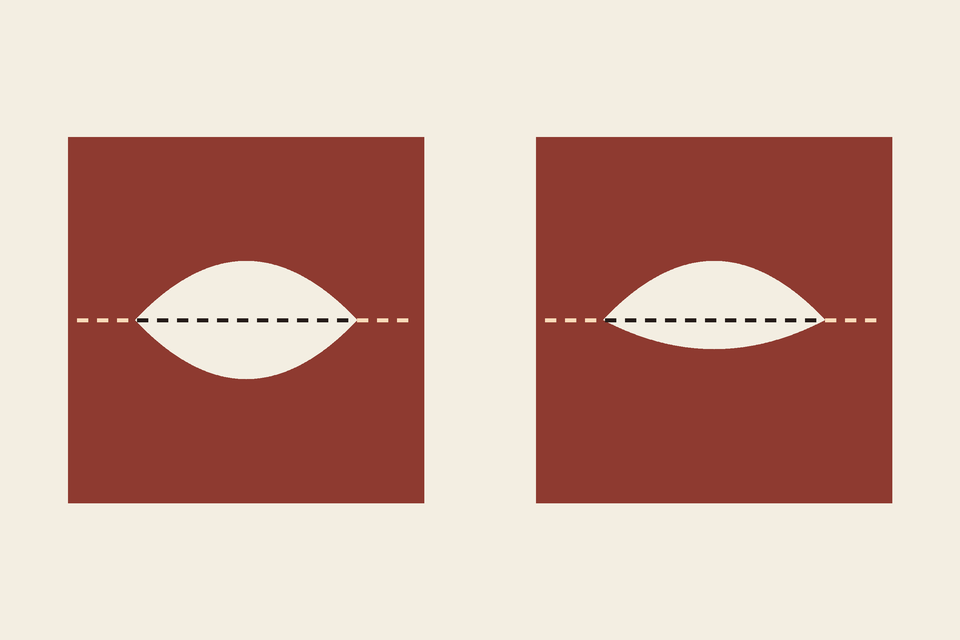
Use the result to choose your next sheet
Write the observations separately for A and B: straight edge intact or split, curved edge intact or split, corresponding cut edges aligned or mismatched, and any layer movement, dragging, or force you actually noticed while cutting. Do not fill in a result because the paper looks thinner or has a particular color. If a curve repeatedly bunches or drags after a supported retry, compare a different paper with the same line.
When both samples work, try the smallest curve or narrowest connection your next pattern actually needs. Success on a broad diamond does not show that a much smaller opening will be equally easy. Keep the size and method the same on the two papers. Either paper may be suitable; there does not have to be a winner. If both straight openings stay intact but only one paper repeatedly holds the target curve without a split under the same conditions, choose that paper for this pattern. If neither works, there is no basis yet for choosing either: change the line size, support, scissors, or candidate paper, and test a comparable pair again.
Keep the paper identity and number of folds beside each sample, together with the observations you made. One fold makes two layers. Fold that stack in half again and the scissors have four layers to cut. In an interview cited in the Palace Museum Journal, Yangzhou paper-cut artist Zhang Xiufang described cutting up to four layers of the traditional xuan paper used there, with each sheet about 60–90 micrometers thick. This records one maker’s practice, not a four-layer limit for every paper and pair of scissors. It shows why the sheet and layer count need to be considered together. If your next pattern has another fold, repeat the two cuts at the new layer count.
Sources: Palace Museum Journal · Research on Fuwangge lacquered gauze, p. 230
Keep the two scraps so you can match the edge of your finished cut to a test you have already done. The folded fish practice cuts the body outline, gill, and body openings through two layers; its eye uses an additional local fold. Choose for that actual layer count and curve size rather than relying on the paper label alone.
BeenEast Editorial. These original diagrams explain the layout and how to read an opening; they are not photographs or A/B test results. The paper-thickness and layer-count reference records one maker’s practice, not a universal cutting limit.
References
Yangzhou Paper Cutting, China Intangible Cultural Heritage Network
Palace Museum Journal · Research on Fuwangge lacquered gauze, p. 230