

How Mother-of-Pearl Inlay Works
See how cut shell and dark lacquer form peonies and scrolls on a Korean stationery box.
By BeenEast Editorial · Published · Reviewed
How shell becomes part of lacquer
Mother-of-pearl inlay is a way of decorating lacquer with shaped pieces of shell. Mother-of-pearl, also called nacre, is the iridescent inner layer of certain shells. Artisans separate that layer, cut it into shapes, and secure the pieces to the object. Lacquer can hold the pieces in place and form the dark ground around them.
Sources: Kyoto National Museum — East Asian Lacquers with Mother-of-Pearl Inlay · The Met — Mother-of-Pearl: A Tradition in Asian Lacquer
How the shell is cut
A flower and a line call for different shapes. In Korean mother-of-pearl work, artisans can use a fine saw or file to shape a piece into a leaf or blossom. They can also cut the shell into narrow strips and arrange the strips to build lines or geometric patterns. The first method gives an individual piece a distinct outline. The second lets the maker build a longer line out of smaller pieces.
Sources: Korea Heritage Service — Najeonjang
The cut shapes are only part of the design. Leaving dark lacquer between pieces makes their outlines visible. Where a maker leaves a narrow gap between petals, that gap can draw a line as clearly as a piece of shell.
Sources: Kyoto National Museum — East Asian Lacquers with Mother-of-Pearl Inlay
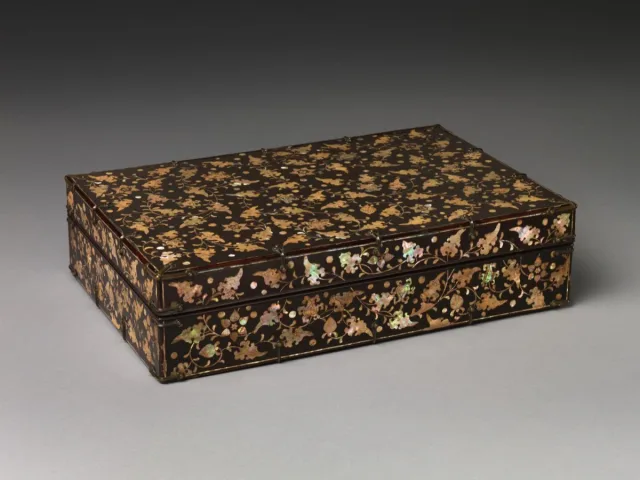
Peonies on a Korean stationery box
On this early Joseon stationery box, the peony scrolls cover the broad lid and continue along the front. The angled photograph shows how the design wraps around the box and where the brass fittings cross the lid seam. The Met identifies the decoration as mother-of-pearl in lacquer and the fittings as brass.
Sources: The Met — Stationery box decorated with peony scrolls
In the close-up, narrow gaps of dark lacquer separate the broad petals around a small central piece. A narrow curved stem passes beside the blossom and leads into a much broader leaf. These outlines show how the design is assembled at different scales.
Sources: The Met — Stationery box decorated with peony scrolls
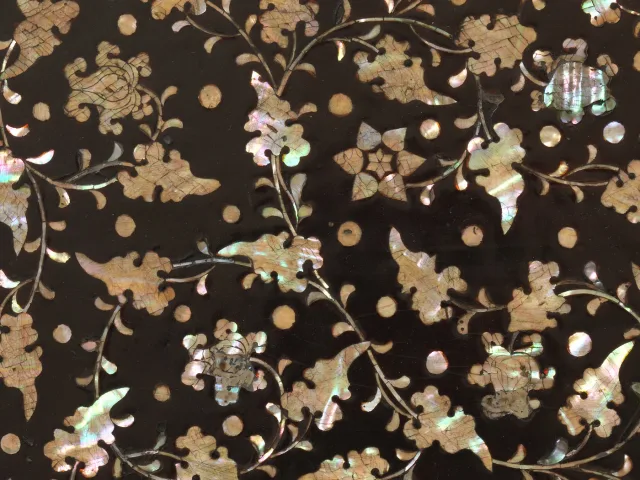
What the shell and lacquer reveal
The close-up also shows pale tan, pink, and green across the shell. Near the upper right, a single leaf catches a green highlight across its lobes. That change in color is consistent with the iridescence of nacre. The outline of the leaf and the gaps around it are better clues to the design than the color of any one reflection.
Sources: Kyoto National Museum — East Asian Lacquers with Mother-of-Pearl Inlay
The Met’s catalog identifies the materials. It gives no details about how thick the shell is, what tools cut it, or how the pieces were set.
Sources: The Met — Stationery box decorated with peony scrolls
Continue reading
Prepared by BeenEast Editorial. The museum photographs show a finished box. The cutting methods describe Korean craft practice.
References
The Met — Stationery box decorated with peony scrolls
The Met — Mother-of-Pearl: A Tradition in Asian Lacquer
Kyoto National Museum — East Asian Lacquers with Mother-of-Pearl Inlay