

How Chinese Woodblock Printing Works
Follow raised lines, open spaces, and two reversals from a carved block to an impression on paper.
By BeenEast Editorial · Published · Reviewed
Start with the surface that takes the ink
Chinese woodblock printing transfers ink from the raised surface of a carved wooden block to paper. The carver removes wood around the lines or shapes that should print, and the printer brings paper into contact with the inked surface. The lower areas leave the color of the paper visible. The impression reverses the block’s design from left to right.
Sources: The Met · Woodblock Printing in Monochrome
The photographs below were shared by the account Jiajiang New Year Prints · Zhang Yan. They show carved blocks and red impressions with related decorative designs. A round frame encloses an open center, while flowers and geometric borders fill the surrounding rectangles. This workshop example gives us a clear way to follow the design from wood to paper.
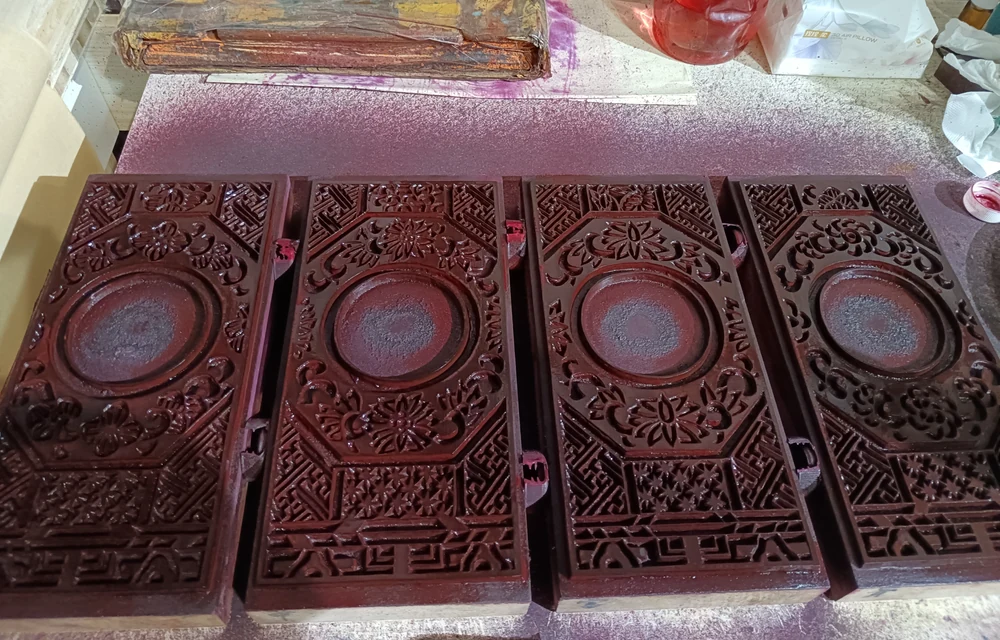
On the third block from the left, broad pointed petals rise above and below the circular frame. Their edges catch the light, and narrow channels separate one petal from the next. The printer needs the petal outlines to remain high enough to meet the paper. Removing the surrounding wood gives those outlines their shape.
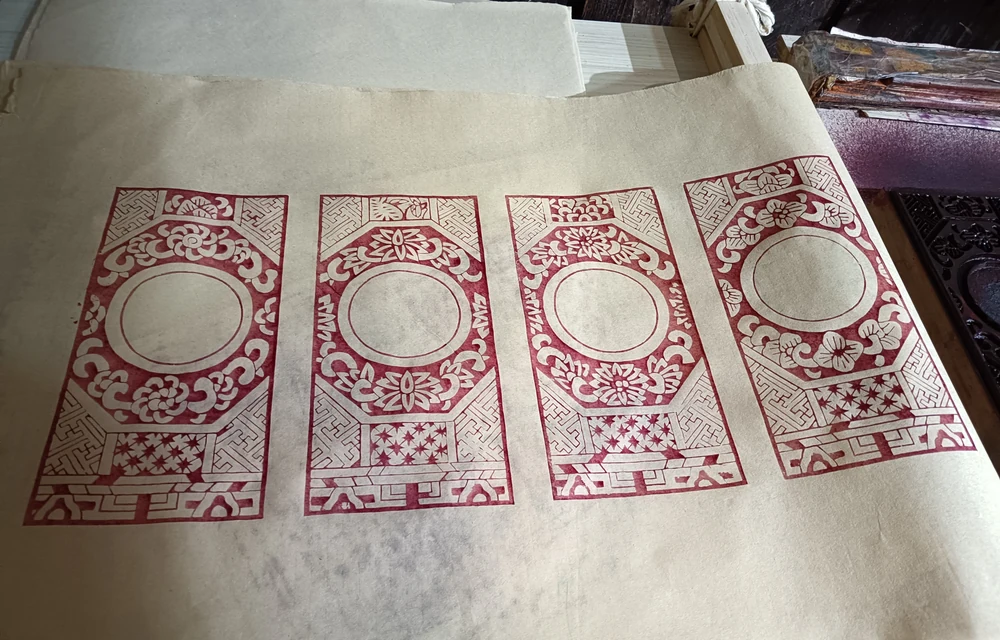
Find the matching pointed petals in the second red impression from the left. Red lines describe the petals, and the pale gaps separate them. The empty circle is especially easy to read because a thin red rim borders a large area of bare paper. The thin red rim separates the open center from the densely patterned border, making the circle easy to distinguish.
Why a cut becomes a white space
Relief printing is the name for printing from a raised surface. Think of the remaining wood as a set of small platforms. Ink sits on their tops, and pressure brings the sheet against them. A cleared channel lies below that contact level, so it can separate two printed lines or open a pale shape inside a dark area.
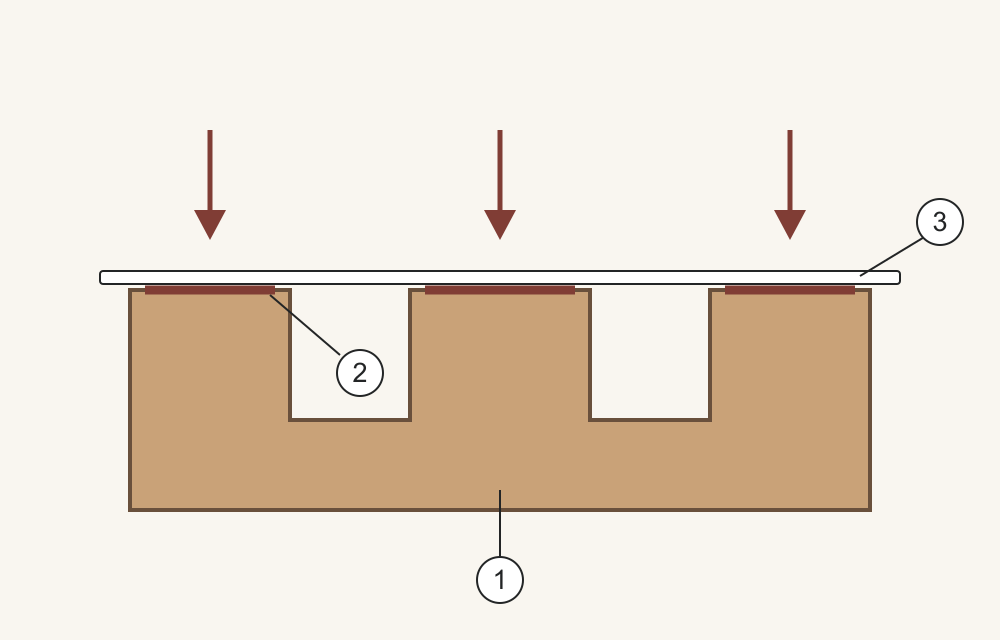
The color of the unprinted space comes from the sheet itself. On cream paper it stays cream, and on white paper it stays white. A dark line drawn on the block can become a printed line if the wood beneath it is retained. Cutting a groove along that same line instead makes a light line in the impression. The decision about which wood to keep changes the image before any ink is applied.
Ink, paper contact, and pressure work together. In a proof, an unexpected dark mark in a pale gap can come from wood left too high or from ink reaching that area. A pale break in an intended line can come from incomplete transfer. The print is useful feedback, but the block and the way it was inked and pressed must be checked together to understand a particular mark.
Follow two reversals
A drawing that should face right on the finished sheet has to face left on the block. One traditional transfer method places a thin sheet bearing the drawing face-down on the wood. The design seen through that paper is already reversed. Carving follows this transferred guide. The Asian Art Museum describes this face-down transfer in its account of Chinese printing.
Sources: Asian Art Museum · The invention of woodblock printing
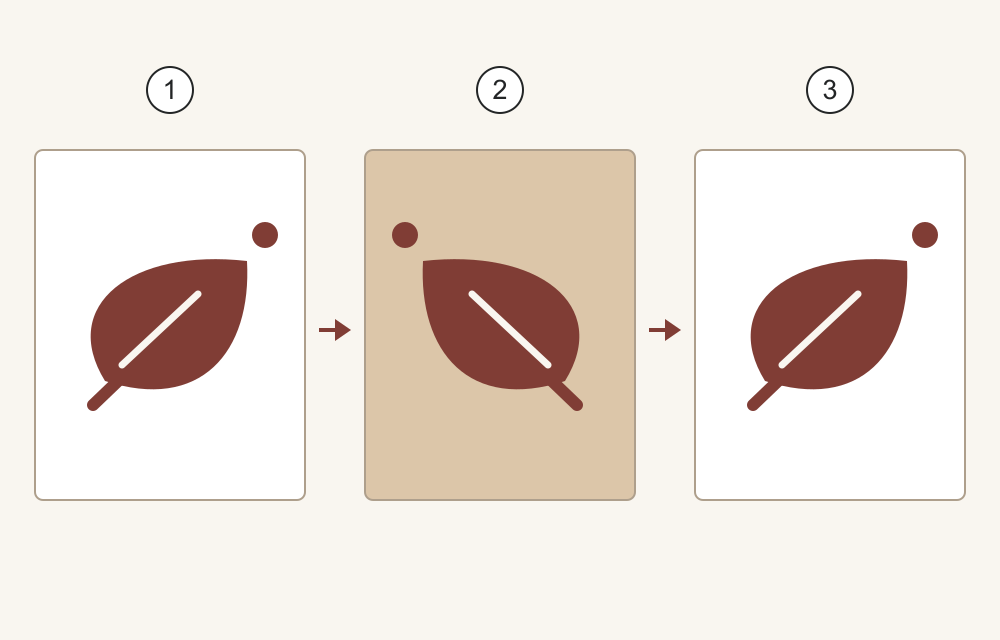
In the diagram, the small dot is to the right of the leaf in panel 1. After a face-down transfer it sits to the left on the block in panel 2. Printing reverses the design again, so the dot returns to the right on the face-up sheet in panel 3. The carving guide and the printed result are viewed from different surfaces.
When planning a design, keep the intended print and the block view distinct. A face-down transfer supplies one reversal. Drawing directly on the wood requires the drawing on the block to have the reversed orientation already. An asymmetric leaf, an off-center dot, or a letter makes a useful reference because its direction is easy to track.
From a carved block to a printed sheet
In the Chinese monochrome process described by The Met, the carved block is brushed with ink, covered with paper, and lightly rubbed from the back before the sheet is lifted to dry. The brush that applies ink works on the wood. The printing pad or rubbing brush works on the back of the paper, helping it meet the inked details below. Keeping those two jobs distinct makes the process easier to follow.
Sources: The Met · Woodblock Printing in Monochrome
A woodblock is the wooden printing matrix, and a woodblock print is the impression made from it. Woodcut commonly names both this relief-printing technique and its resulting prints. Relief printing is the broader family, which also includes printing from carved linoleum or rubber. Those materials have different cutting behavior from wood.
Tutorials under these English terms can use different inking systems. A roller spreads a film of relief ink over a block. Japanese mokuhanga uses brushed water-based color and a hand-rubbing tool called a baren. The Chinese brush-printing process discussed here applies ink to the wood and transfers it through paper-back pressure. When choosing a practical tutorial, identify its wood, ink, paper, and pressure tool as one working set.
Sources: Jackson’s Art · Woodcut printmaking methods
Return to the red impressions above and follow one petal from its red outline into the pale gap beside it. The red edge records wood kept at the printing surface. The gap records an area that did not receive that ink. Together, they turn the carved block’s pattern of high and low surfaces into an image on paper.
Continue reading
Prepared by BeenEast Editorial. Workshop photographs were shared by the account Jiajiang New Year Prints · Zhang Yan. The cutaway and reversal diagrams are original BeenEast illustrations.
References
The Met · Woodblock Printing in Monochrome
Asian Art Museum · The invention of woodblock printing