

Printed Color and Brush Color in a Nianhua
Follow one contemporary Yangliuqing design from separate blocks to brown printed hair and a brush-painted red mouth.
By BeenEast Editorial · Published · Reviewed
One design, two ways of adding color
In this Yangliuqing New Year picture, or nianhua, the brown hair is printed from a separate block, while a brush adds red directly inside a mouth. We can distinguish them because a documentary follows the blocks, intermediate impressions, and the brush touching that same character design. A finished photograph alone would not establish that division.
Sources: Path to Nowhere · Yangliuqing collaboration documentary
The case is a 2025 collaboration between the game Path to Nowhere and Yangliuqing artisans Huo Qingshun and Zhang Hong in Tianjin, China. Huo works on the carved blocks in the film; Zhang demonstrates printing and brush coloring. The two cartoon figures belong to this contemporary collaboration. They are not presented here as traditional door-god subjects, and the film does not identify the individual who drew the original game character designs.
Sources: Path to Nowhere · Yangliuqing collaboration documentary
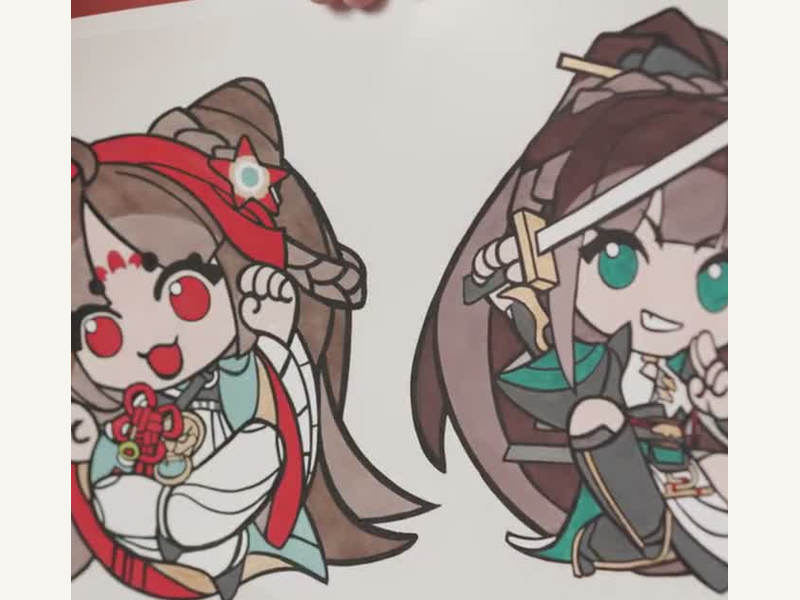
Use the star-shaped hair ornament to recognize the same figure in the paper impressions and painting close-up. The curved hair shapes connect those paper views with the brown reliefs. The pictures below show stage details; the completed detail above supplies their color context.
What the line block and color block carry
The lower block in the detail carries narrow raised lines: the outlines and internal details of the two figures. In relief printing, those remaining surfaces transfer ink; the cut-away spaces do not form the printed lines. The separate brown blocks above carry broader hair-shaped areas. They can add color to parts of an existing outline impression without redrawing all of its small features.
Sources: Path to Nowhere · Yangliuqing collaboration documentary
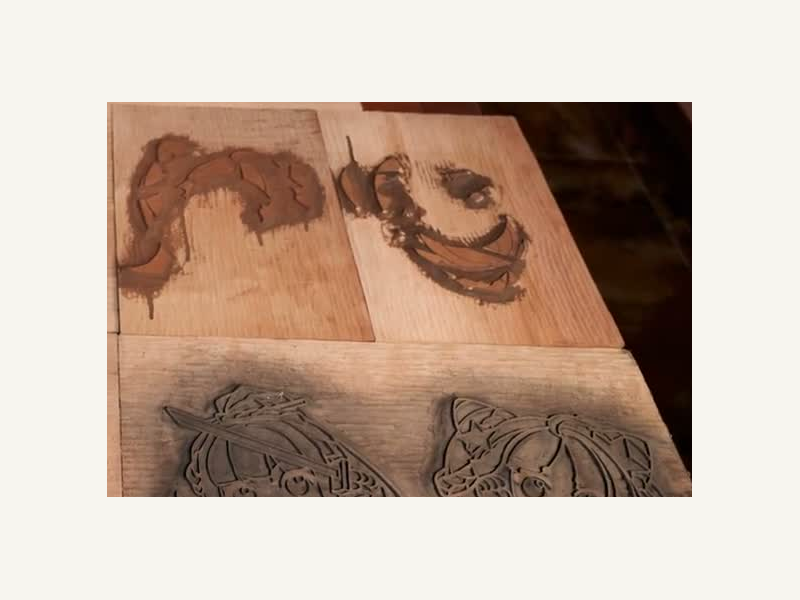
The block detail makes the difference between broad color surfaces and narrow contour lines visible. The curve of the hair helps connect the brown relief with the later impressions. On the paper views, use the star-shaped ornament to locate the same character. The block reverses the image, and the paper turns between shots, so page-left and page-right are not stable identifiers.
A colored print therefore need not use one complete picture block for each visible color. A local block can carry several separated patches of one color. Conversely, several visible colors do not by themselves reveal how many blocks were used: some may have been added with a brush. This film documents a separated set, not a verified block count or a complete recipe for every colored area.
From block coloring to intermediate impressions
At 4:47 a brush spreads color over the brown hair-shaped relief. Pigment reaches the shaped block before the paper contacts it. Registering means positioning a new impression so its intended areas meet the contours already printed on the sheet. For the hair, the desired relationship is color inside its surrounding black boundary.
Sources: Path to Nowhere · Yangliuqing collaboration documentary
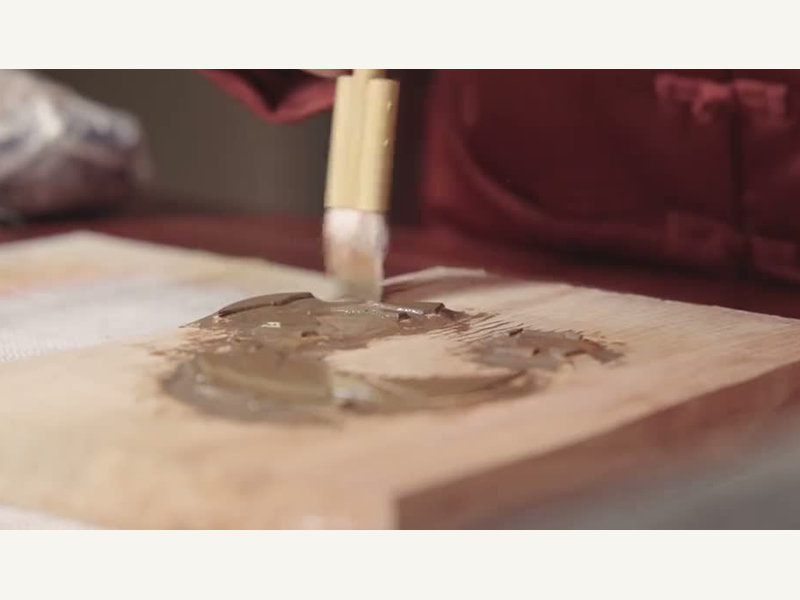
The broad brush in the next view presses across the paper back over another color block. Black contours and pale pink eye areas show through the sheet. This demonstrates paper-to-block pressure, while the preceding image demonstrates coloring the brown block. They are different color-printing moments in the film, not a continuous record of one brown impression.
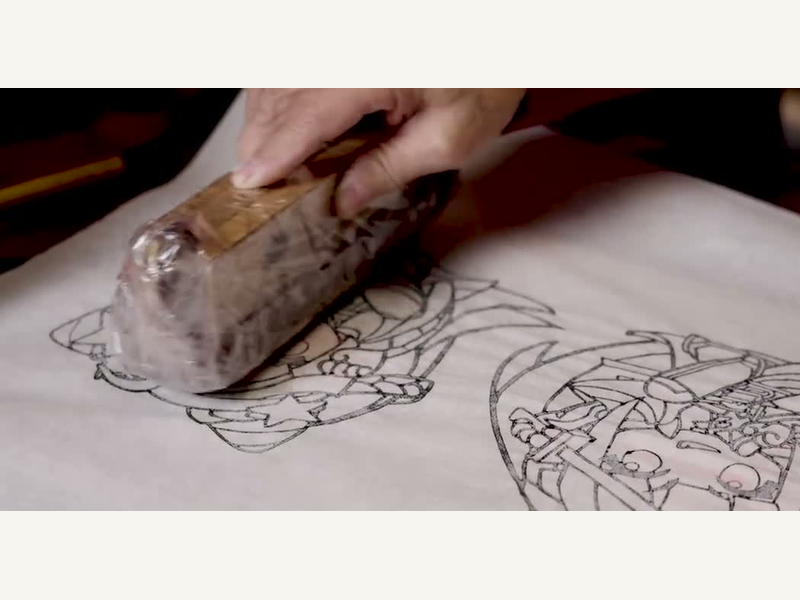
The film then shows intermediate impressions at different stages. In the view below, brown occupies the hair around the star ornament. Its curved hair shapes correspond to the separated brown relief and the block-coloring close-up. Those records support the printed origin of this area; the preceding pale-color rubbing shot does not document its individual transfer. The slightly broken brown texture alone would not prove the method.
Sources: Path to Nowhere · Yangliuqing collaboration documentary
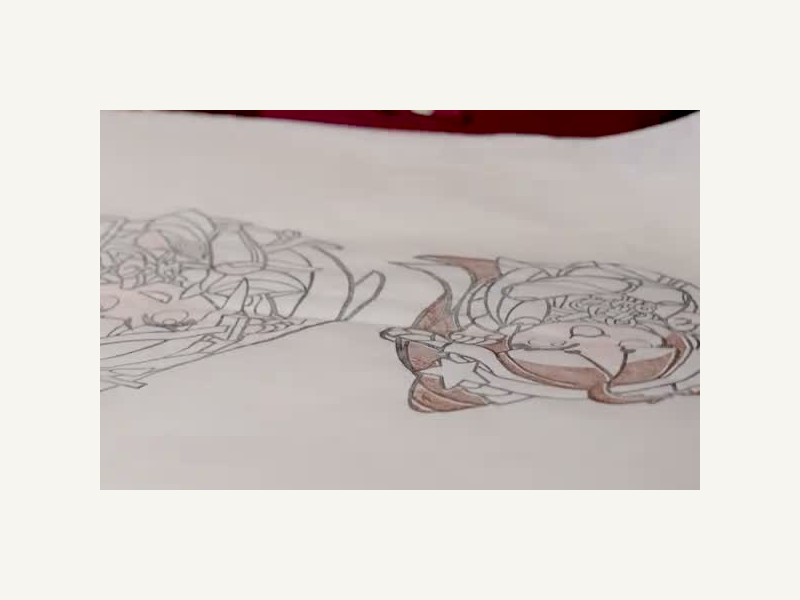
The edit does not show every paper contact or a fully traceable registration stop. It connects this design with its printing surfaces and intermediate color, while leaving the workshop’s exact positioning setup unrecorded.
Where the brush adds color
At 5:24 the contact changes. A brush touches the mouth directly on the printed paper. The brown hair remains visible, while red fills the small mouth within its dark boundary. This establishes a hand-painted addition in that particular area after the printed-color stage shown earlier.
Sources: Path to Nowhere · Yangliuqing collaboration documentary
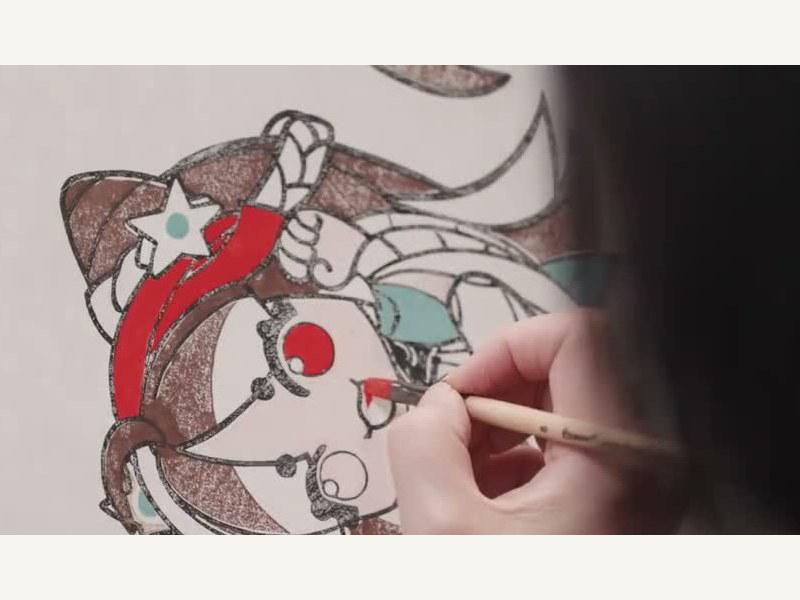
There are red and pale blue areas already present when this close-up begins. Their presence tells us the picture has advanced, but this single shot does not explain how each of those areas was made. In particular, the red headband and the red mouth cannot be assigned the same method just because their colors look alike. The mouth has direct action evidence; the headband would need its own stage record.
“Printed and painted” describes a division of work, not a fixed percentage. The line block establishes a repeatable framework; local printed color adds selected areas; the brush can work directly within that framework. How much is printed or painted depends on the documented work. Neither the phrase nor a bright finished image establishes a universal color order, drying interval or pigment mixture.
Sources: Smithsonian Folklife Festival · New Year’s Prints, Tianjin
Read the record of a historical print
A historical comparison shows why the place name alone is insufficient. The Metropolitan Museum of Art records New Year’s Day, dated 1747, as a Suzhou woodblock print in ink with additional hand coloring, object 2025.376. That medium record supports the presence of both printing and hand coloring. It does not identify each brush-colored passage or state how many color blocks were used.
Sources: The Met · New Year’s Day, 1747, object 2025.376
That differs from the evidence available for the contemporary collaboration: there we can connect a particular brown hair area and a particular red mouth to recorded actions. For the historical work, we have the object’s medium attribution without that continuous workshop record. Do not fill the gap by assuming that all Suzhou prints are purely color-block printed, or by applying this Tianjin demonstration’s sequence to a 1747 object.
The Smithsonian’s Yangliuqing documentation offers a useful account of workshop roles: Gao Yan makes outlines, Wang Wenda carves blocks, and Chen Yuhua adds color by hand after printing. It corroborates the combination of printing and painting in that recorded tradition. The documented roles help explain the division between carving, printing and brushwork.
Sources: Smithsonian Folklife Festival · New Year’s Prints, Tianjin
Make a small, checkable observation
When reading another nianhua, choose one small area before trying to explain the whole sheet. Record what is visible, what a source demonstrates, and what remains unknown. For this case: “brown hair beside a star ornament” is visible; “that area is transferred from a color block” is supported by the process sequence; the exact pigment formula remains unknown.
A useful question for a maker or collection record is: “Which areas come from the line block and color blocks, and which are painted directly on the paper? Is there an intermediate impression or a process photograph of this design?” A separate block, an intermediate result and the corresponding action are more informative than a claim that a print merely looks handmade. This is an editorial observation method, not an authentication test.
In the star-ornamented figure, the printed hair and the brush-painted mouth meet within a shared black framework. Recognizing that division makes the finished color easier to read. If you want to move from observation to a first practical color print, continue with the two-color registration guide; its exercise has a different documented design and setup.
Common questions
Was the red headband painted just because the red mouth was painted?
The mouth close-up directly shows a brush adding red there. The headband is already red when that shot begins, so this frame does not establish how its color was made. Matching colors can come from different steps. The headband needs its own process record before you assign it the mouth’s method.
Sources: Read the full explanation
Does “printed and painted” mean exactly half the picture is hand-painted?
It describes a division of work rather than a fixed percentage. Printed outlines provide a repeatable framework, printed color can fill selected areas, and a brush can add color directly on the paper. How much each process contributes must be checked for the particular work; the phrase does not supply a universal ratio or color order.
Sources: Read the full explanation
Continue reading
References
Path to Nowhere · Yangliuqing collaboration documentary