

How wire outlines a cloisonné pattern before color
linlin ·
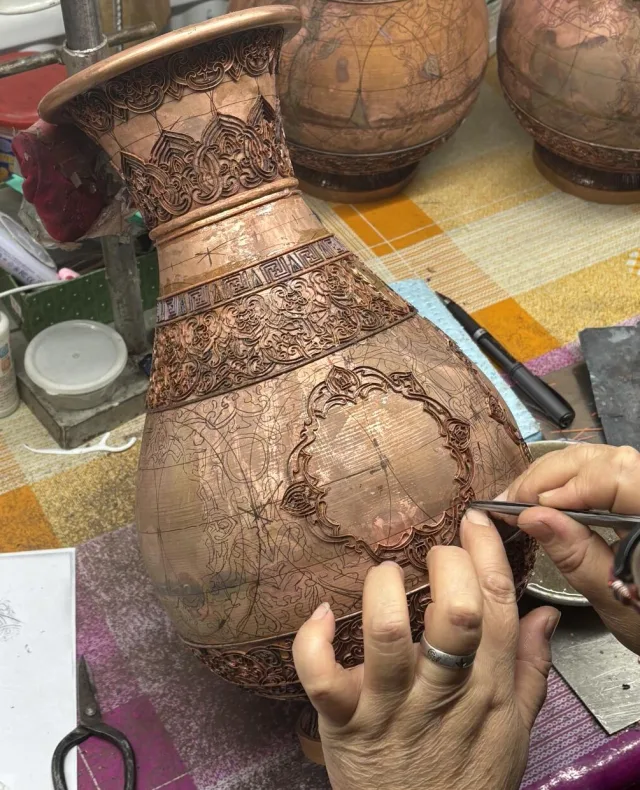

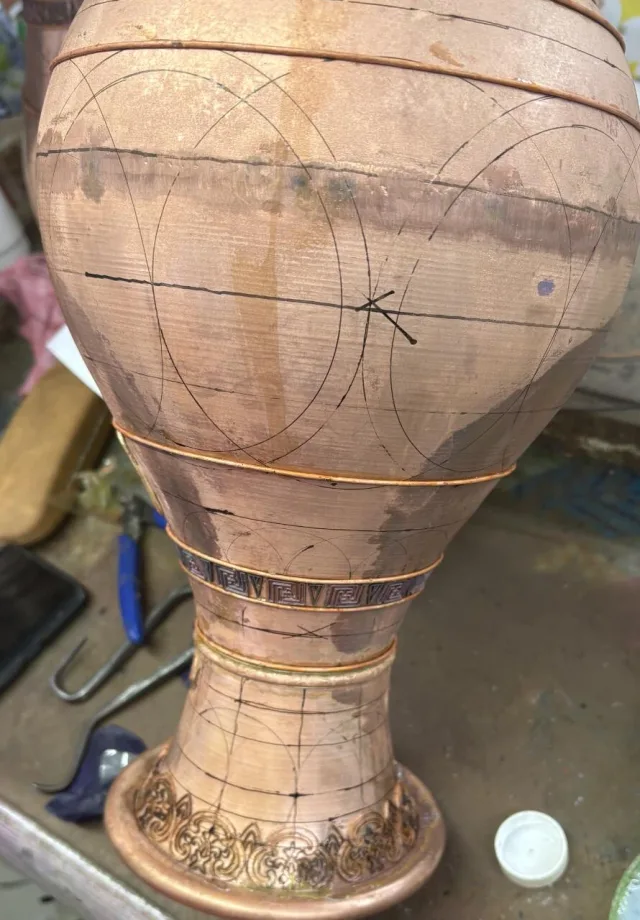
In these unfinished copper vases, the raised curls and borders are made from copper wire, while the flatter dark marks are drawn guides. Cloisonné is an enameling technique in which narrow metal partitions form compartments for colored enamel. Before the color is added, it is easier to see how the drawn design becomes a metal outline.
Follow the medallion edge
In the first photo, follow the lobed border around the open medallion. A hand holds tweezers beside its lower-right edge, and closely spaced wire curves repeat around the frame. Inside the border, the copper remains exposed. The photographs show workshop views of wire-setting details; they do not establish a complete sequence for one vase.
Compare the bands with the bare body
The upright vase in the second photo shows a different relationship between drawing and wire. Dense scrollwork fills a band below the neck, while larger drawn curves remain visible across the rounded body. Narrow horizontal borders divide the decoration into zones. Compare a dark drawn line with a raised wire edge: the wire has thickness and catches light along its side.
Separate layout guides from wire
Turn to the upside-down vessel in the third photo. Large drawn ovals cross horizontal guides on the broad body, while wire rings and a decorated band are already visible nearer the foot. These are different kinds of marks doing different jobs: guides position the design, and applied wire builds its boundaries.
What to look for
When looking at an unfinished cloisonné piece, choose one small area and trace both kinds of line. Look for the height, shadow, and highlight of the wire beside the flatter drawing. That distinction helps you read the work already in place without treating every visible line as a finished enamel boundary.