

Dunhuang’s Thousand Buddhas on the Qianxiang lacquer cup
guoguo ·
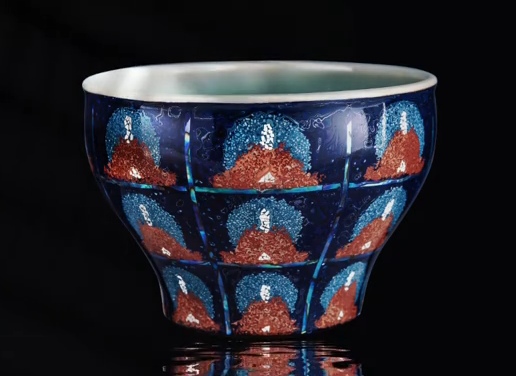
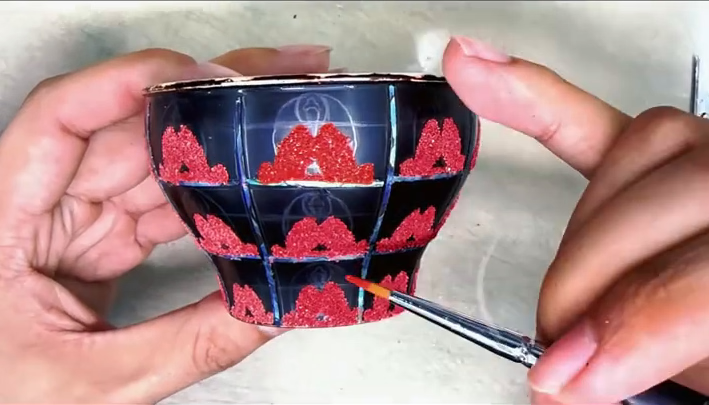
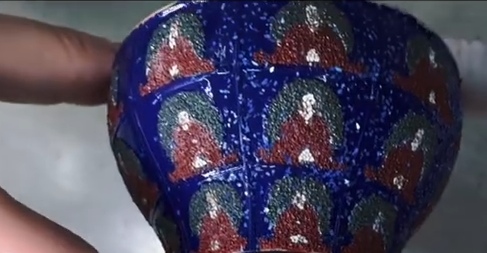
On the Qianxiang lacquer cup, reddish-orange seated Buddhas repeat in three bands. The figures are wider just below the rim and more compact as the cup narrows toward its foot. In her original post, Tang Tian traces the arrangement to the Thousand Buddhas paintings at Dunhuang. In Mogao Cave 272, for example, groups of small Buddhas on the ceiling alternate in cool colors, including white and green. On the cup, the repeated figures carry the eye around a curved surface.
Follow a row around the cup
In the view with the fine brush, horizontal bands and upright lines mark the positions of the figures. Faint outlines are still visible above some of the red shapes. Compare this view with the finished cup. The figures below the rim have broader shoulders. In the narrower cells below, each one takes up less space. Follow a blue-green divider around one row, then follow a line down toward the foot. The repeated figure changes width with the shape of the cup.
Look for the eggshell and mother-of-pearl
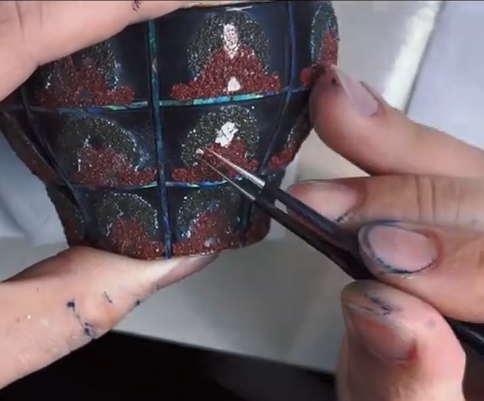
The tweezers bring a tiny pale fragment to an orange figure. The video identifies this stage as eggshell inlay. In the next close-up, small flecks dot the blue lacquer after mother-of-pearl has been added. Tang’s description also mentions zhangxiu, a family of lacquer finishes in which layers of color are textured and polished to reveal a pattern. Compare the two close-ups with the finished cup. The small pale inlays help you pick out the figures’ heads, while tiny glints remain scattered in the blue between them.
About the work and Tang Tian
Tang Tian shared the process video for Qianxiang. Its opening credits name Yitang Studio at the School of Art, Tianjin University of Technology. Tang is an associate professor and master’s advisor at the university and holds the title of provincial-level Master of Arts and Crafts. Her work explores how traditional lacquer techniques can inform contemporary design.
 Lacquerware
Objects and guides on lacquer.
Explore Lacquerware Looking at a piece →