

How to Wash and Store Hand-Dyed Textiles
Check the care label before washing a hand-dyed piece. Learn when to finish a new dye project, how to spot rub-off, and how to dry and store the textile.
By BeenEast Editorial · Published · Reviewed
Check the care instructions for the whole piece
For a finished hand-dyed textile, use the maker’s directions for washing and drying. Check both before you wet the piece. A plain cotton cloth may be washable, but a bag made from the same cloth can have a lining, stiffener, or leather trim that needs different care.
Sources: FTC — Clothing Care Labels
If the label allows machine washing, use the stated cycle, temperature, and drying method. If it calls for hand washing, use that method. When a lined, mounted, or fragile piece has no instructions, check with the maker or a textile conservator before putting it in water.
Sources: Canadian Conservation Institute — Basic Care for Textiles
Finish a new dye project before routine washing
If a class sample went home before its final rinse and wash, finish it using the instructor’s or dye kit’s directions. That wash removes dye left over from the process. A finished scarf or shirt already sold for use follows its own care label.
For example, Jacquard’s indigo kit calls for rinsing and washing after the dyeing cycles. Dharma’s fiber-reactive tie-dye instructions use a staged rinse followed by a hot washout. Those instructions belong to the specific dye processes. For a finished piece, use the water temperature on its care label.
Sources: Jacquard — Indigo Kit Quick Start, Dyeing Step 5 · Dharma Trading — Tie-Dye Instructions, Washout
Tell wash-water color from rub-off
If color enters the wash water, the dye is bleeding. If blue shows up where a dry or damp textile rubs against another surface, that is rub-off, also called crocking. For example, blue on the seat of a pale chair after sitting in dark denim points to contact transfer. Clear rinse water alone does not tell you how the cloth will behave against upholstery.
Sources: Levi’s — Dark Denim and Dye Transfer
Follow any separate-wash instructions. If you find rub-off, keep the piece away from pale clothing and upholstery while you check the maker’s advice. A photo of the mark and a note about where it appeared, whether the cloth was damp, and what you last washed it with will help the maker suggest a next step.
Support the cloth as it dries
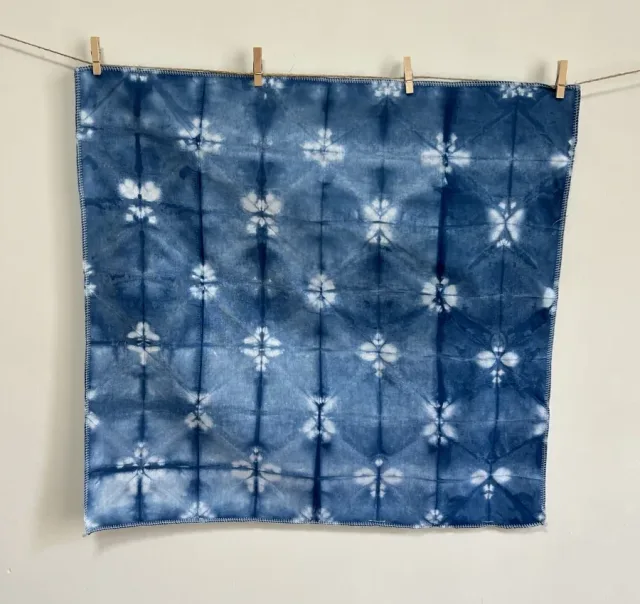
Choose the drying method on the care label. In the photo, clips hold a small square cloth along its top edge. A wet knit has more weight to support, especially at the shoulders and sleeves.
Sources: Woolmark — How to Dry a Wool Sweater
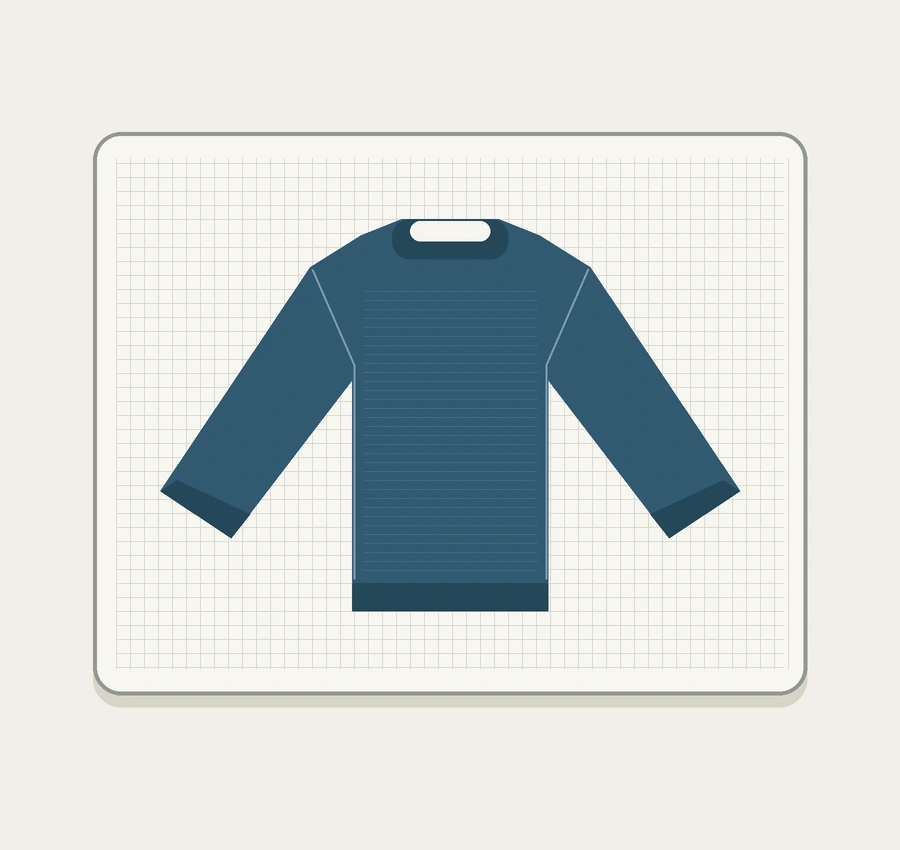
For a washable wool sweater labeled for flat drying, lay it on a clean drying mesh or lint-free towel. Ease it back into shape and support the sleeves on the same surface. Dry it out of direct sun and away from heaters.
Sources: Woolmark — How to Dry a Wool Sweater
Store it dry, with room at the folds
Before putting the piece away, feel the thickest seam, folded hem, and lining. They can still feel damp after the exposed surface has dried. Once the whole piece is dry, lay small flat textiles in a drawer or box away from direct light.
Sources: Canadian Conservation Institute — Basic Care for Textiles · Canadian Conservation Institute — Flat Storage for Textiles
If the box is too small for the piece to lie open, make as few folds as possible. For long-term storage of a delicate textile, support each bend with unbuffered acid-free tissue so the cloth curves around it. Keep heavy items off that fold.
Sources: Canadian Conservation Institute — Flat Storage for Textiles

Continue reading
Reuse and citation
English PDF and Markdown contain the text; their photo links open the illustrated guide.
BeenEast Editorial. How to Wash and Store Hand-Dyed Textiles. Version 1.0 (2026-11-13). https://community.beeneast.com/guides/hand-dyeing-care
The photograph shows a hanging textile. The drying and storage drawings are original BeenEast illustrations.
References
Jacquard — Indigo Kit Quick Start, Dyeing Step 5
Dharma Trading — Tie-Dye Instructions, Washout
Levi’s — Dark Denim and Dye Transfer
Woolmark — How to Dry a Wool Sweater