

How to Choose a Hand-Dyed Bag
Use a hand-dyed patchwork bag to check what fits, how the loaded strap feels, and whether the dyed fabric and care instructions suit your routine.
By BeenEast Editorial · Published · Reviewed
Start with what you carry
Choose a hand-dyed shoulder bag around what you carry and wear. Check that the bag closes around your usual items and that the loaded strap sits comfortably over your clothes. If the bag will rub against pale fabric, check color transfer in the conditions you expect. Then choose the patchwork pattern you want to receive.
The Indigo Collage bag in the BeenEast catalog is our example. Its photos show the opening, strap hardware, and front panel. The listing leaves usable interior dimensions, strap measurements, load limits, rubbing results, and care instructions unspecified.
Measure the opening and the space inside
Measure your widest rigid item as you plan to slide it in. On the bag, measure the clear opening between the ends of the closure. Once the item is inside, check the usable width, depth, and front-to-back room with your usual contents in place.

In the example below, a 7 × 9 in. (about 18 × 23 cm) notebook goes in short edge first. It won’t pass straight through a 6½ in. (16.5 cm) opening. An 8 in. (about 20 cm) opening leaves 1 in. (about 2.5 cm) of total clearance across the width.
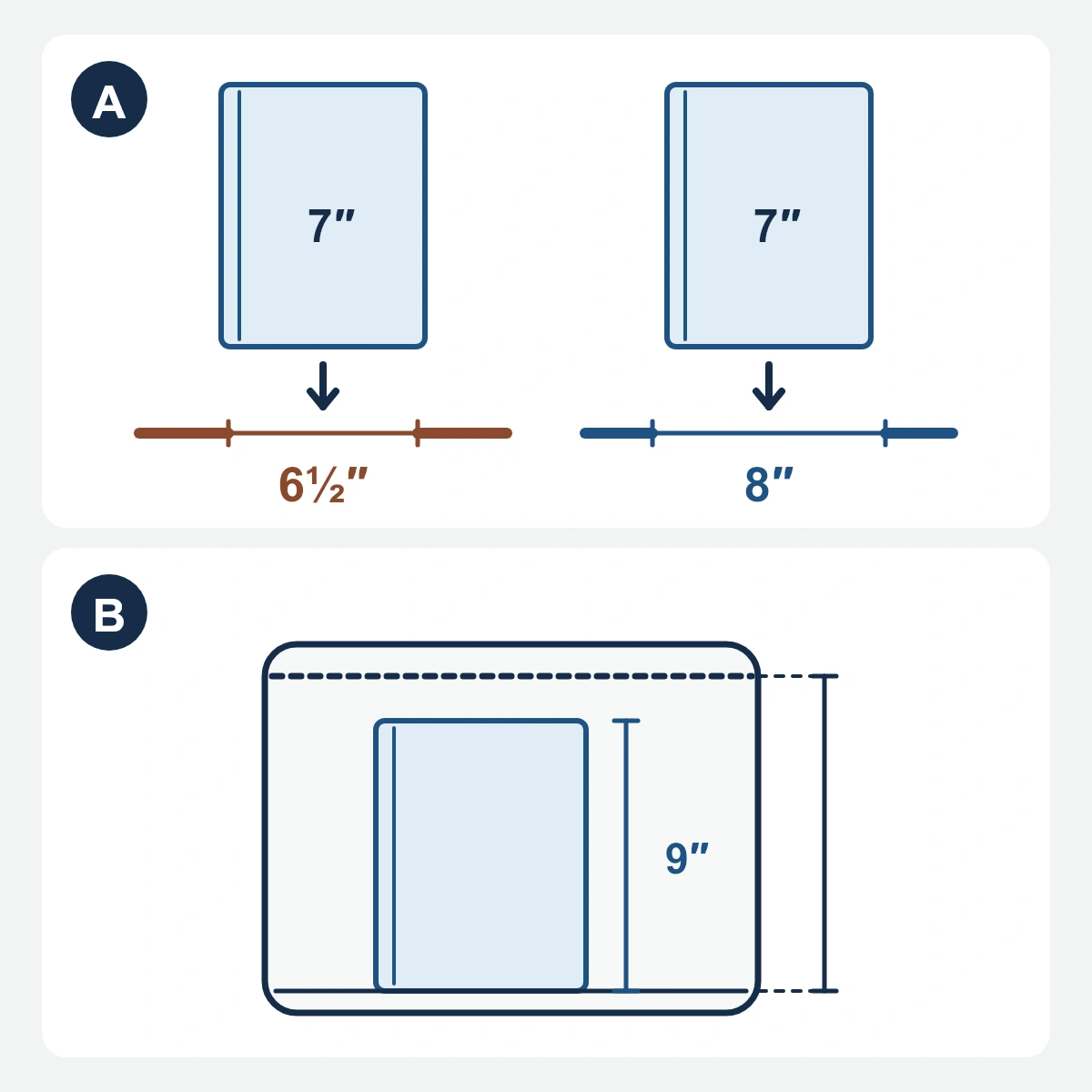
To check closure, set the notebook on the bottom with the rest of your usual contents in place. In this orientation, the bottom to the closed opening must accommodate the full 9 in. height (about 23 cm). Check that the closure meets without catching the notebook or pulling the rim out of shape. If you’re buying online, ask for the inside measurement from the bottom to the closed opening and a photo with a similar item inside and the bag closed.
Measure the strap and try the bag loaded
Measure the strap
| Measure | Where to measure |
|---|---|
| Length and adjustment range | Measure along the strap from one clip’s contact point on the ring to the other. Include the clips and straighten the strap gently. For an adjustable strap, measure both ends of its usable range. |
| Strap drop | Hang the bag naturally. Measure straight down from the highest point of the strap to the top of the bag. |
| Shoulder contact width | Measure across the strap where it rests on your shoulder. |
The catalog photos of this Indigo Collage bag show the clips and braided strap. A measured strap length, drop, and shoulder contact width for this sample are still unverified.
Use the same measurement on a bag you already wear comfortably. Check shoulder and crossbody settings separately, over the layers you normally wear.
Inspect the attachments
The clips pull on the rings, and the tabs sewn into the rim carry that pull into the bag. Check both tabs for broken stitches, gaping seams, or torn fabric. For a repaired tab, a close-up and a view of any reinforcement inside can help you assess its condition.

Try it with your usual load
Pack your usual items, close the bag, and wear your usual shirt or coat. Walk a few steps and reach for something. The bag should sit within easy reach, the strap should lie flat, and the rim should stay even with the bag closed.

Use the top edge between the two clips as a reference. When you try the bag with your own things inside, compare that edge before and after putting it on. A twist or gap that appears as the strap takes the load is a reason to repack and check again.
If the strap slides, rolls onto an edge, or a buckle digs into your shoulder, try a different setting or a wider, flatter strap. If the rim still twists or gaps after you repack, choose a bag that closes comfortably with your usual load. Online, a loaded side photo can show where the bag sits and how the rim closes. Try it on to judge pressure and slipping.
Choose the panel you’ll actually receive
The pale patch on this bag meets a dark blue panel, and a dotted patch sits near the side. Cutting from a different part of the dyed cloth changes where those colors and marks meet the seam. If you’re choosing for the pale patch in the upper left, compare the listing with a photo of the exact bag you’ll receive.

A pale dye edge on intact cloth is a pattern detail. Frayed cloth pulling away from a seam calls for a closer look because the join may be opening. Color that rubs onto a light jacket is a separate wear issue. Check it under the contact conditions you expect, as described below.
Choose for your clothes and cleaning routine
Check the dyed panel or strap that will touch your clothes. Use dry and damp white-cloth results from that area or matching finished fabric. AATCC TM8 tests dry and wet rubbing separately. A maker’s informal check applies to the fabric and conditions they checked.
Sources: AATCC — Color transfer by rubbing
| What the check shows | What to choose |
|---|---|
| Dry cloth picks up color | Wear it with dark clothes or choose a different bag for light clothes. |
| Only damp cloth picks up color | Wear it against light clothes in dry conditions. Switch bags if rain or sweat could dampen the contact area. |
| Damp result is unknown | If dry rubbing leaves no visible color, reserve it for dry wear against light clothes until you have the damp result. |
| Neither cloth shows visible color | Favor it for daily wear with light clothes if the tested areas and conditions match how you’ll use it. |
“Wash separately” is a laundry instruction. If that is all the maker provides, both rubbing results are still unknown.
| Cleaning needs | What to choose |
|---|---|
| Clean small marks | A spot-clean-only bag can work if the maker gives a method for the finished bag that you can follow. |
| Wash the whole bag | Choose a bag whose maker allows whole-bag washing and explains how to wash and dry it, including whether to remove the strap and how to handle the lining and hardware. |
If you regularly need to wash the whole bag and the listing only identifies a cotton outer fabric, choose a model with explicit instructions for the assembled bag.
Continue reading
Reuse and citation
English PDF and Markdown contain the text; their photo links open the illustrated guide.
BeenEast Editorial. How to Choose a Hand-Dyed Bag. Version 1.0 (2026-11-13). https://community.beeneast.com/guides/hand-dyeing-choose
Prepared by BeenEast Editorial. The catalog photographs show the same bag from different angles. The capacity diagram uses hypothetical dimensions.