

How to Look at a Hand-Dyed Textile
Follow the lines on an indigo-dyed square from the whole cloth to a close-up, then use the same method to read another textile.
By BeenEast Editorial · Published · Reviewed
Read the whole cloth
Start with the outline of the cloth, then follow one line from the center toward an edge. In this home-dyed cotton square, pale arcs cross the upper half and dark lines fan out below the deep blue center. The full view shows how the pattern fills the square. The close-up reveals where a line breaks or softens.
Follow a line into the close-up
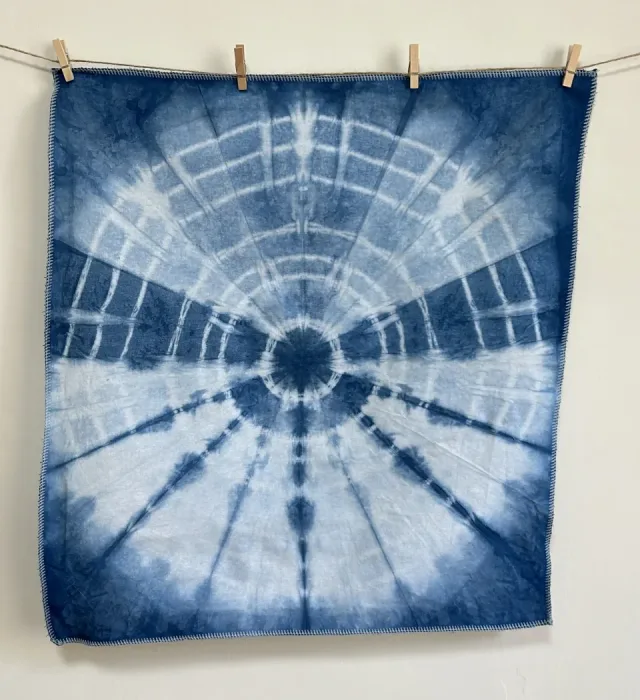
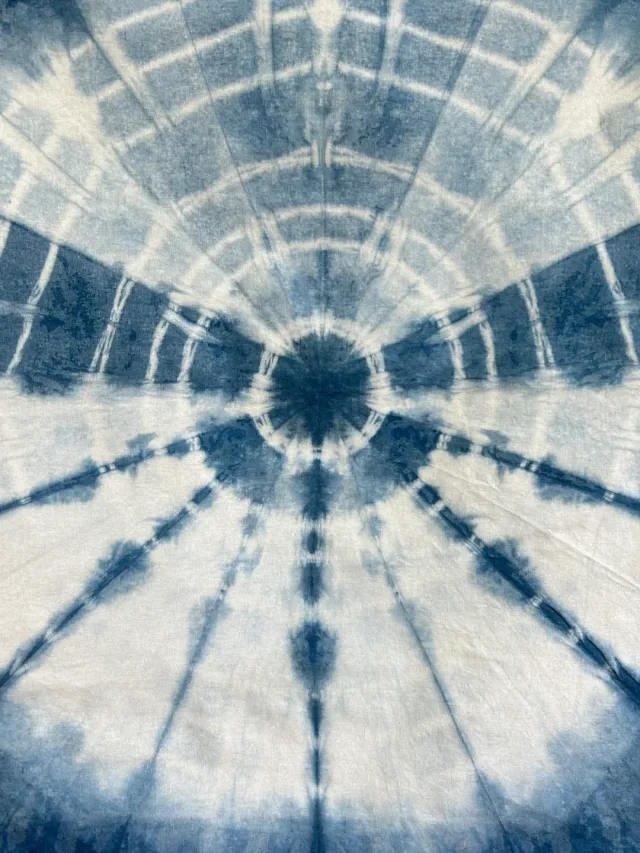
The dark blue center links the two views. Just above it, pale arcs cross several blue wedges. In the close-up, some arcs stay distinct across a dark wedge and grow harder to follow over paler cloth. A single line can look crisp in one spot and diffuse in another. Its contrast with the surrounding blue affects how clearly it reads.
In tie-resist dyeing, ties limit where dye reaches the cloth. In Zhoucheng, a village in Dali, Yunnan, tying precedes dyeing in the Bai tie-dye tradition. China’s national heritage register describes small, evenly spaced motifs, often drawn from nature. The photographed cotton square comes from a separate home dyeing record. To connect one arc to a particular tie, you would need a photo of that spot before the cloth was untied.
Sources: China Intangible Cultural Heritage — Bai Tie-Dyeing
Where the pattern meets the edge
In the full view, a dark line runs down from the center into the blue along the lower edge. The close-up ends above the bottom edge, so the full view is where you can check that relationship. To tell how the edge is finished, you would need a detail of the edge itself. On a sewn piece, a line of stitching or a join between panels can interrupt a pattern even when the dye marks continue to the edge of each panel.
Compare the same spot in both views
The blue at the center looks different at the two scales. The full view includes a light wall and more of the dark border. The close-up fills the frame with cloth. When comparing color, match the same spot and use photographs taken in similar light. If you are photographing your own piece, take the full view and detail under the same light and keep the cloth at the same angle.
Describe one line and ask one question
A useful note for this square is, “The pale arc above the dark center crosses a dark wedge and softens over lighter blue.” If you want to know how the arc formed, send the marked detail and ask the maker for a photo of that part while the cloth was still tied. The dark center gives both of you the same place to begin.
Continue reading
Resources and citation
English PDF and Markdown contain the text; their photo links open the illustrated guide.
BeenEast Editorial. How to Look at a Hand-Dyed Textile. Version 1.0 (November 13, 2026). https://community.beeneast.com/guides/hand-dyeing-looking