

What Is Urushi Lacquer?
Follow lacquer from tree sap to a hardened film, then see how East Asian makers use it as a coating, a carving material, and a base for inlay.
By BeenEast Editorial · Reviewed
From the lacquer tree
Natural lacquer comes from sap that seeps out of shallow cuts in the bark of the lacquer tree (Toxicodendron vernicifluum). Urushi is its Japanese name. In Chinese, the freshly collected sap is commonly called shengqi (raw lacquer). The broader material is also called daqi. Makers can apply it as a coating, build up layers for carving, or use it as a base for inlay. On a label, “lacquer” can also mean another kind of finish, so look for the material name.
Sources: Kew Science — Toxicodendron vernicifluum · The Met — Lacquerware of East Asia
In Maoba, a town in Lichuan, Hubei, People’s Daily reported in 2024 that lacquer tapper Yang Dezhi made a V-shaped cut in the bark and set a shell below it to catch the milky sap. A separate 2018 Xinhua photo essay shows Pang Chaoyuan making a crescent-shaped cut, collecting sap in a shell, and pouring it into a lacquer canister.
Sources: People’s Daily · Lacquer tapping in Maoba (2024) · Xinhua · A lacquer tapper in the mountains (2018)
Pingli County in Shaanxi, in the Qinba Mountains, is another Chinese example of a raw lacquer-producing area.
Sources: Pingli County Government · Raw lacquer in Pingli
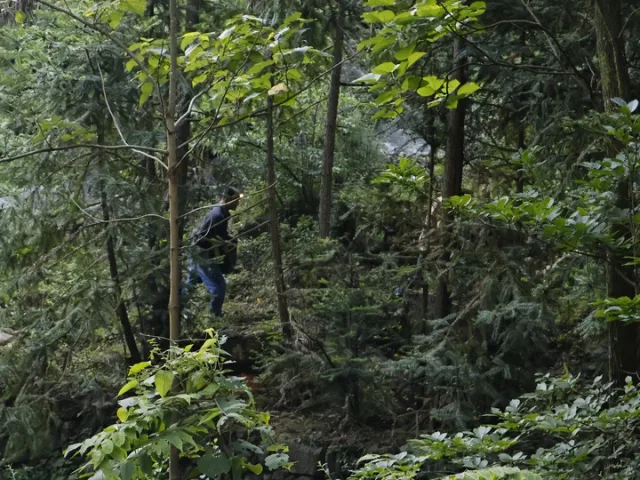
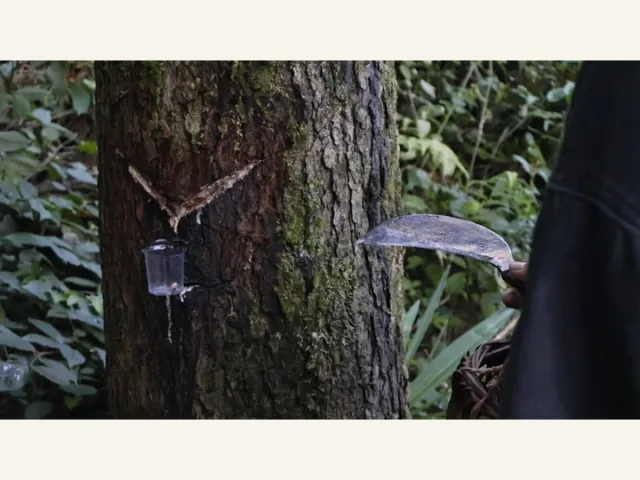
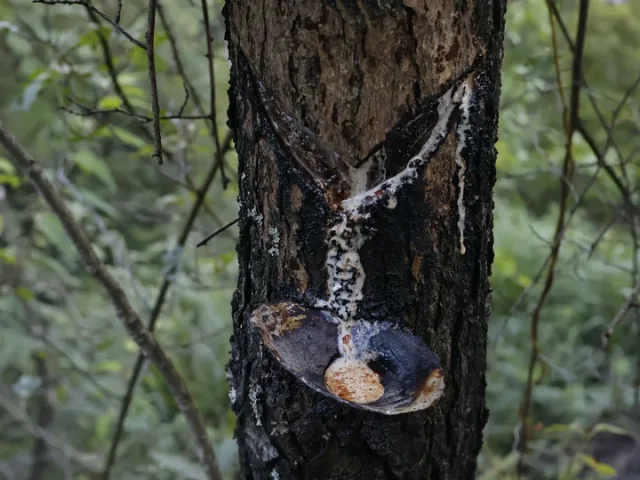
These photographs show a separate example of lacquer tapping in China. The exact woodland location was not specified. The photographs do not show either of the Maoba demonstrations above or a sequence on a single tree. Look for the cut and the container just below it. A clear cup appears in one view and a shell in another.
How sap hardens into a film
Urushiol is a group of compounds in the sap. Laccase, an enzyme naturally present in the sap, helps start a reaction with oxygen. The urushiol molecules link into a network, turning the liquid layer into a solid film. Moisture supports the enzyme, which explains why makers cure lacquer in a humid space. Water can leave the coating during curing, but evaporation alone does not form the film.
Sources: Yang et al. — Polymerization mechanism of natural lacquer sap
Uncured lacquer can cause a skin reaction. A finished museum object illustrates what the hardened material can do. Handling raw lacquer is a separate workshop skill.
Sources: The Met — Lacquerware of East Asia
Three jobs lacquer can do
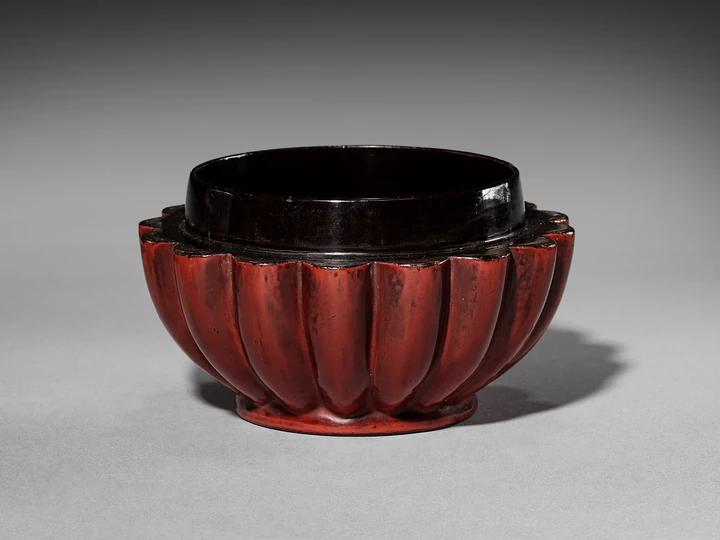
As a coating, lacquer follows the object’s shape and gives it a hard working surface. On the Japanese tea caddy below, the wood supplies the fluted shape. Red lacquer follows those contours over a black undercoat. The two colors belong to different layers of the finish.
Sources: Cleveland Museum of Art — Tea Caddy (Chaire) · The Met — Lacquerware of East Asia
In Pingyao, in China’s Shanxi province, makers use thin coats of natural lacquer to build up the surface of objects such as chests and screens. They let the coats cure and level the final coat before polishing it with the palm and a fine abrasive. The fine polish brings out the gloss. See “How Does Pingyao Lacquerware Get Its Gloss?” for the workshop process.
Sources: China’s national heritage register — Pingyao lacquerware · China Culture Daily — Workshop interview with Wang Hailian
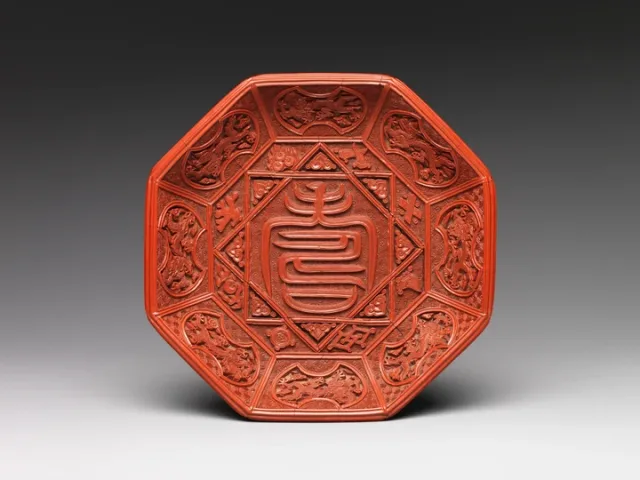
As a carving material, lacquer needs enough depth for a tool to cut into it. Makers build up successive coats, then remove lacquer where the design should sit lower. On the Ming dish, the lower ground makes the central longevity character stand out. The relief is in the lacquer itself.
Sources: The Met — Dish with character for longevity (shou) · The Met — Lacquerware of East Asia
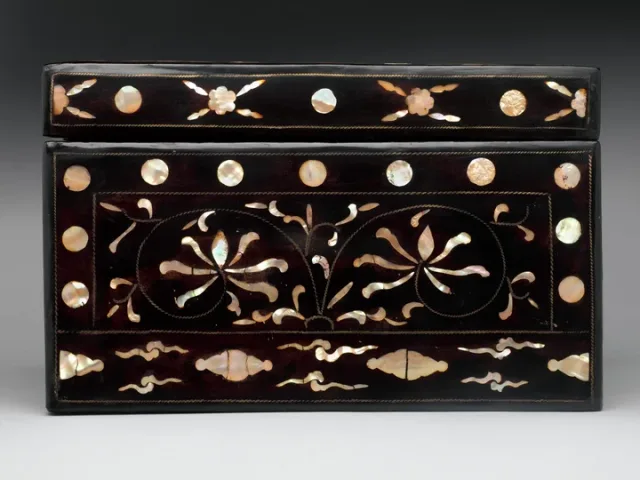
As a base for inlay, lacquer works with another material to make the pattern. On the Korean box below, pale shell shapes sit within the dark lacquer surface and twisted metal wires draw some of the stems. The catalog also records tortoiseshell. Here the surface pattern depends on the boundaries between the lacquer and the inserted materials.
Sources: The Met — Box decorated with flowers and clouds
Reading a material label
A useful material description tells you what carries the shape, what forms the surface, and what makes the design. “Lacquer on wood” names a coating and its support. “Carved lacquer” tells you where the relief was cut, but may leave the support unspecified. “Lacquer inlaid with mother-of-pearl” identifies pale shell pieces as part of the surface. Gloss alone cannot answer any of those material questions.
Sources: Cleveland Museum of Art — Tea Caddy (Chaire) · The Met — Dish with character for longevity (shou) · The Met — Box decorated with flowers and clouds
Continue reading
BeenEast Editorial reviewed Chinese reporting, lacquer research, and museum records. The field photographs document a separate example of sap collection in China. The museum photographs illustrate three uses of lacquer.
References
Kew Science — Toxicodendron vernicifluum
Wajima Museum of Urushi Art — Urushi tapping
V&A — Where lacquer comes from
Yang et al. — Polymerization mechanism of natural lacquer sap
The Met — Lacquerware of East Asia
Cleveland Museum of Art — Tea Caddy (Chaire)
The Met — Dish with character for longevity (shou)
The Met — Box decorated with flowers and clouds
People’s Daily · Lacquer tapping in Maoba (2024)
Xinhua · A lacquer tapper in the mountains (2018)
Pingli County Government · Raw lacquer in Pingli