

How to Choose Your First Lacquerware Workshop
Choose a first class by the handwork you want to learn, compare real examples in China, and use an English inquiry to check the details.
By BeenEast Editorial · Published · Reviewed
1. Choose the handwork you want to learn
Choose your first lacquerware workshop by what you will do with your hands. If you enjoy drawing, consider a design-and-gold-leaf class. If arranging small pieces appeals to you, look for an inlay class that includes placing shell. If you are curious about how a surface becomes smooth, consider polishing. For a one-time visit, the class must also fit your departure date and the studio’s plan for finishing and releasing the piece.
The three programs below took place in China in 2026 and have ended. They show how to compare future classes; they are not current booking listings.
For drawing and surface decoration, Shanghai Art Museum’s October 6 badge workshop offered a concrete sequence: prepare a black ground on an aluminum-alloy base, transfer a design, paint it in lacquer, lay gold leaf, and brush away excess leaf. Designed by Weng Jijun, the course focused on decorating a small object rather than building its body.
Sources: Shanghai Art Museum — Lacquer Badge Workshop, October 6, 2026 (Chinese)
For finishing, the Liu Haisu Art Museum branch in Shanghai offered polishing of a shell-inlaid lacquer box during China Lacquer 2026, August 15–September 13. That description identifies the handwork as polishing an existing surface. It does not promise that students will cut or place the shell themselves.
Sources: Putuo District — China Lacquer 2026 and the Lacquer Box Polishing Workshop (Chinese)
For a course spread over several visits, Beilun Cultural Center in Ningbo scheduled an adult mother-of-pearl pendant course with Mao Weifeng on May 14, 21, 26, and 28. Its four meetings establish the time commitment, but the announcement does not divide the project into individual operations. A longer schedule alone does not tell you which steps you will perform.
Sources: Beilun Cultural Center — Mother-of-Pearl Pendant Course, May 2026 (Chinese)
Read a course description as a sequence of actions. “Polish a shell-inlaid box” describes a finishing class. “Arrange and set shell pieces” describes participation in the inlay. “Make a lacquer box” leaves both possibilities open. A useful reply from a studio names the parts it prepares, the actions you perform, and the work it completes afterward.
2. Understand the materials and prepared parts
Daqi is the Chinese term for natural tree lacquer, a coating made from lacquer-tree sap. A workshop may provide a body and earlier coatings already prepared, so your first task can be decoration or finishing. The Shanghai badge program, for example, describes its black ground as a simulation of the base-coating stage. That exercise does not establish that students make the full traditional coating system.
Sources: Shanghai Art Museum — Lacquer Badge Workshop, October 6, 2026 (Chinese) · The Met — Lacquerware of East Asia
Eggshell inlay uses pieces of eggshell. Mother-of-pearl inlay, called luodian in Chinese, uses the lustrous inner layer of mollusk shells. Both can form designs in a lacquer surface, but they are different materials. The pale fragments in the Shanghai workshop photograph below belong to an eggshell-inlay example; they should not be described as mother-of-pearl.
Sources: Isabella Stewart Gardner Museum — From Tree Sap to Tea Jar: East Asian Lacquer · The Met — Mother-of-Pearl: A Tradition in Asian Lacquer
For either kind of inlay, separate shaping the pieces from arranging them and from finishing the surrounding surface. A class using prepared pieces can focus on placement. A class using an already inlaid object can focus on polishing. Neither description implies that you will learn to cut shell. The Met’s account of mother-of-pearl distinguishes cutting, trimming, and polishing shell pieces from the further work of inlaying them into lacquer.
Sources: The Met — Mother-of-Pearl: A Tradition in Asian Lacquer
Gold leaf is an extremely thin sheet of gold used for surface decoration. In the badge example, the main learning task is the relationship between the painted design and where the leaf remains. When choosing a similar class, establish which coating and leaf the studio actually supplies; the historical announcement does not provide a complete materials list.
Uncured tree lacquer contains urushiol and can cause allergic contact dermatitis. A hands-on course should explain its material-specific protection, cleanup, and handling arrangements before wet work begins. Follow those arrangements under the instructor’s supervision.
3. Know what a beginner should practice
At an eggshell-inlay workshop at Shanghai International Design Festival, a participant draws a flower outline on a red panel beside a shell-decorated example. This is the design stage. The workshop’s published account also describes placing eggshell pieces with tweezers; the photograph itself shows drawing, not that later operation.
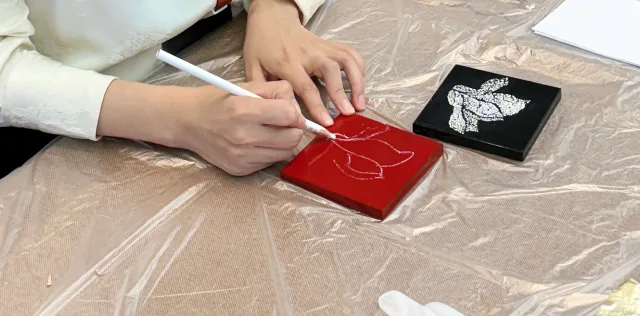
For a placement class, a useful learning goal is to arrange pieces within a motif while controlling the spaces between them. The pale flower on the black sample shows why spacing matters: dark gaps separate its fragments and remain part of the design. Ask the teacher to demonstrate placement on the actual prepared surface. Drawing the outline introduces the pattern, but a class aimed at inlay should give you time to work with the pieces themselves.
The Shanghai badge program offers a different learning path: transfer a motif, paint its lines in lacquer, apply leaf, and clear the excess. Each stage has a purpose. The transferred motif guides the brush; the painted design determines where the metallic decoration is intended to remain. A demonstration on a sample lets you see that relationship before working on your badge.
Sources: Shanghai Art Museum — Lacquer Badge Workshop, October 6, 2026 (Chinese)
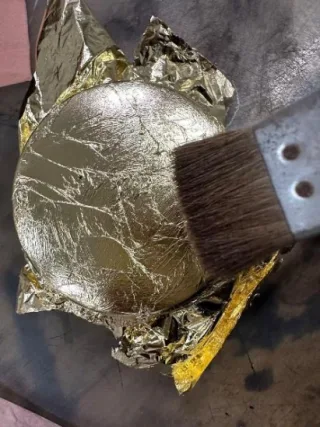
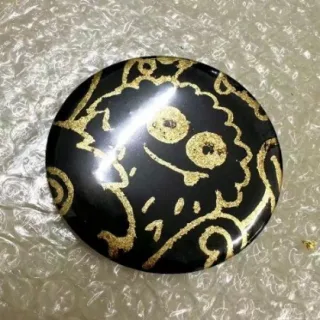
A practical result to discuss with the instructor is whether neighboring lines remain distinct after the loose leaf is cleared. On the finished badge example, black gaps separate the gold-colored lines around the eyes and outer contour. This gives the lesson a visible goal beyond simply covering the object with leaf.
For a polishing class, the learning goal changes: you need to recognize the surface change the teacher is seeking and when to stop at that stage. Before booking, favor a course that includes a demonstration and feedback on your own work. A finished box photograph alone cannot show how those skills will be taught.
4. Fit the course to your visit
Lacquerware is built through successive applications, with each layer allowed to harden before further work. A short class can enter that process at a prepared stage. Finishing the activity during class and receiving an object ready to use are therefore separate milestones.
Sources: The Met — Lacquerware of East Asia
The Shanghai badge program describes one evening; the Ningbo pendant course spans four meetings. Neither establishes a general curing time. For your chosen course, the studio should identify any remaining coating, hardening, polishing, or hardware attachment, who does it, and when the piece can be collected.
If you will leave the city after one visit, a course with a confirmed collection date or an agreed shipping arrangement may fit your trip. A course that requires you to return for another operation will not fit the same itinerary. Shipping availability, destination, and cost need a direct answer; none is confirmed by the historical cases here.
Teaching language matters during demonstrations as well as introductions. Confirm that you can follow material handling, the teacher’s corrections, and the stopping point for your task. The linked Chinese activity pages do not establish English-language instruction or current availability.
5. Ask about a class in English
Use the historical announcements to identify an institution and the type of activity you want, then find its current official program or contact channel. Ask about the next beginner session rather than trying to reserve one of the ended events. You can adapt the message below for an email or direct message.
Copy the following message and replace the bracketed details:
Hello, I’m a beginner interested in your [workshop name or technique] class in [city]. I’ll be visiting on [dates] and can attend [one session / several sessions]. Do you have a suitable upcoming class?
I’d like to learn [drawing and gold leaf / placing eggshell or mother-of-pearl / polishing]. Which steps would I do myself, and which parts would already be prepared? Will the instructor demonstrate the technique and give feedback while I practice?
Is instruction available in English, including material handling and safety guidance? What materials will I handle, and what protective equipment is provided?
How many sessions are required, what is the total price, and what does it include? When will the piece be ready to collect? If it needs more time, can you ship it to [destination], and at what cost? Please also send the booking and cancellation terms. Thank you!
Use the reply to match the class to your goal. Prepared shell pieces that you arrange yourself offer practice in placement; an already inlaid box that you polish offers practice in finishing. Either can be a worthwhile first lesson when the operation you want to learn is the one you will actually perform.
Continue reading
References
Shanghai Art Museum — Lacquer Badge Workshop, October 6, 2026 (Chinese)
Putuo District — China Lacquer 2026 and the Lacquer Box Polishing Workshop (Chinese)
Beilun Cultural Center — Mother-of-Pearl Pendant Course, May 2026 (Chinese)
The Met — Lacquerware of East Asia
Kawai et al. — Patch Tests on Lacquerware Students
Isabella Stewart Gardner Museum — From Tree Sap to Tea Jar: East Asian Lacquer