

What Should I Look at Before Choosing a Cloisonné Piece?
Look at form, surface, condition, and the maker’s description before deciding what suits you.
By BeenEast Editorial · Published · Reviewed
Judge the construction, condition, and purpose separately
Choose a cloisonné piece by relating its design and surface to its documented construction, present condition, and intended use. A dense pattern or a brilliant blue may attract you, but neither measures workmanship on its own. First establish whether the listing describes fired glass enamel, what metal supports it, and which areas are gilded or otherwise finished. Then judge the actual object within that description.
A contemporary wearable, a decorative vase, and a historical collector’s object ask different questions. A fastener and exposed edges matter for jewelry; stability and fittings matter for a vessel; restoration and attribution evidence matter for an antique. A repaired piece may still suit your aims, but its repair history should be part of the decision rather than hidden inside a general condition grade.
Read how the design works around the form
At a distance, look at silhouette and the distribution of ornament. On the tall vase pictured, compare the narrow neck, rounded body, and foot, then follow where the floral pattern changes with the form. For a candidate you are considering, inspect the back and sides too: a frontal photograph cannot show how a band closes or how a motif continues around the shoulder.
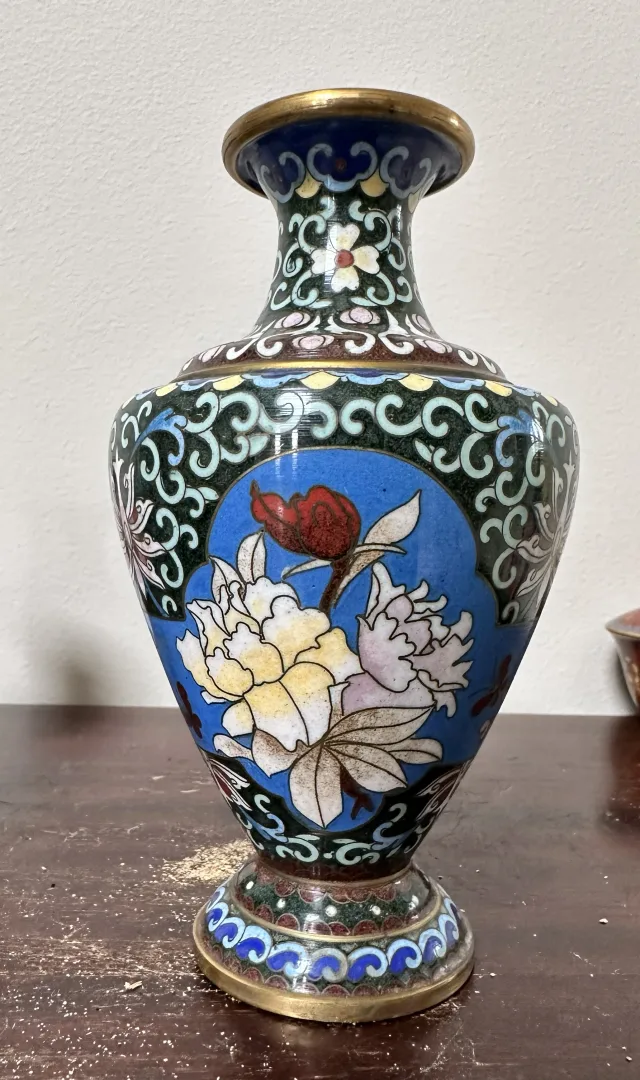
At close range, inspect wire curves, junctions, and the relationship of the line to its neighboring color. Ask whether the line serves the design and whether the detail remains legible where several cells meet. These are editorial ways to compare the visual work, not a numerical grading system. The Ashmolean’s contrast between Yasuyuki’s detailed wire and Sōsuke’s painterly approach demonstrates why more visible wire is not a universal sign of better work.
Distinguish surface character from a condition problem
On a conventionally leveled cloisonné surface, the exposed wire edges and surrounding enamel are read together. Ashmolean collection notes describe repeated firing and prolonged polishing used to obtain a smooth surface. Examine the reflection as the view changes: it can help you locate uneven areas, while a close detail can show whether a colored field is continuous or has a visible loss. Intentional raised decoration also exists, so flatness is a criterion only when that is the stated finish.
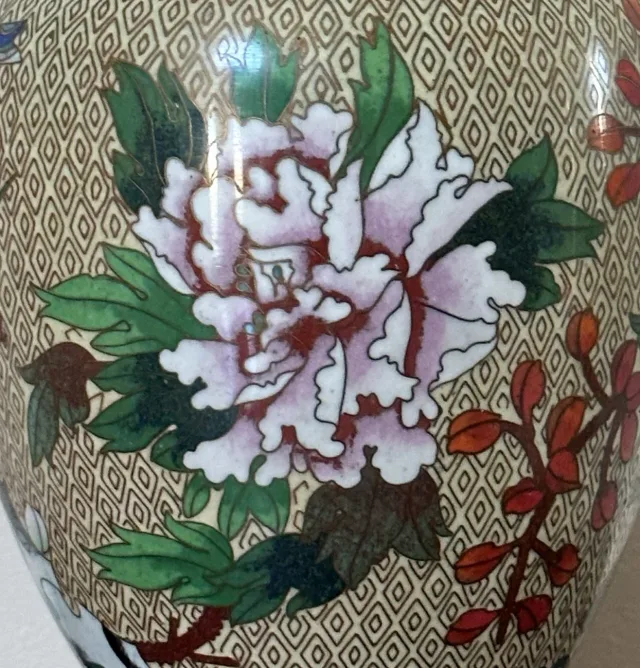
A small pit, a shallow depression, a line crossing several cells, a chip exposing a lower layer, and a visibly lifted edge are different observations. Ask for each to be shown at a useful scale. Do not relabel a pit as a crack, assume a crack’s cause, or accept “handmade variation” as an explanation for a missing area. A condition report should identify the feature and its location. The pictured flower is a separate example from the vase, not a before-and-after comparison.
Inspect fittings, finishes, and repairs as parts of the object
Request views of the rim, underside, interior, lid seat, handles, and fastener as applicable. These are where the relationship between decorated body and attached parts becomes visible. A vessel can look complete from the front while a foot or handle has a different condition. A yellow rim should be described as a documented gold finish or an observed color, not assumed to be solid gold.
The CCI explains that abrasive polishing removes surface material and can damage plating. A brighter appearance is therefore not automatically better preservation. For a patch with different gloss or color, ask whether it is a known repair, retouching, wear, or unresolved condition issue. Compare the seller’s answer with a close image and a written description. Identifying a repair’s material or stability may require examination; color mismatch alone is not proof.
Use the answers to make a concrete decision
Consider two different replies: “fired glass enamel on copper with a gilt rim and a disclosed repaired chip” explains construction and a condition issue; “antique enamel, excellent condition” leaves both attribution and condition largely unresolved. The first reply does not make a piece suitable for every buyer, but it provides facts you can weigh against your intended use. Ask for the missing evidence that would change your decision rather than collecting generic assurances.
For an antique claim, establish whether the date and origin are an expert attribution, a signed record, documented provenance, or only a seller’s estimate. For everyday use, obtain instructions specific to the object. A bowl form and lead-free ingredients alone do not establish suitability for food contact. Decide whether you are accepting an explained condition, paying for an unsupported claim, or choosing a piece whose use and care you understand.
Continue reading
References
Victoria and Albert Museum · A guide to metalworking techniques
Canadian Conservation Institute · Caring for metal objects
The Crucible · Guide to Vitreous Enameling