What Is Cloisonné Enamel? Follow the Wire Between the Colors
Follow three views of a pair of blue vases to see how a metal body, wire partitions, and fired glass shape the pattern.
By BeenEast Editorial · Published · Reviewed
How metal and glass make a pattern
Cloisonné enamel decorates metal with colored glass. The maker bends thin metal strips, sets them on edge to form compartments, and fills those spaces with glass enamel. Heat fuses the enamel. On many finished pieces, the exposed tops of the strips trace fine lines between the colors.
Sources: The Met · Chinese Cloisonné
Beijing jingtailan is a Chinese tradition of cloisonné enamel made on a copper body. Its makers use flattened copper wire for the pattern. The deep blue on these vases is one color in a palette that also includes pink, pale blue, and green.
Sources: China Intangible Cultural Heritage · Beijing Jingtailan
The body sets the space for the design
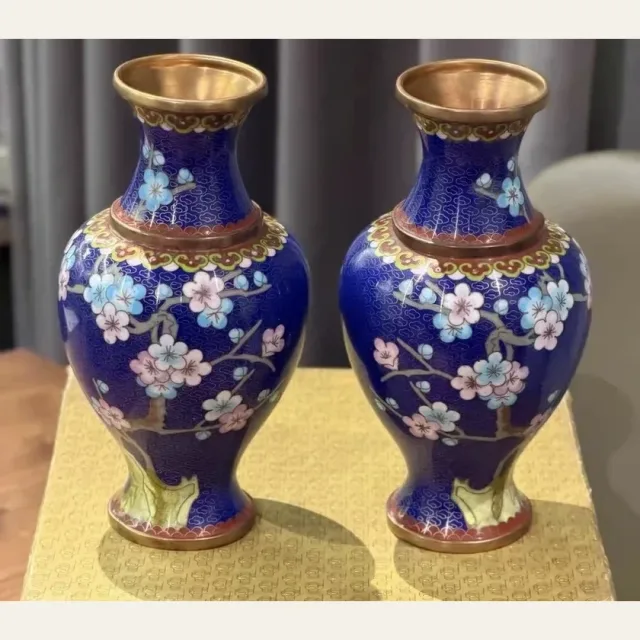
These two vases flare at the mouth, narrow at the neck, and widen again at the belly. The branches have room to spread across the widest part. At the neck and foot, narrow bands follow the circumference. On a curved body, those bands have to meet around the back.
One strip gives two colors an edge
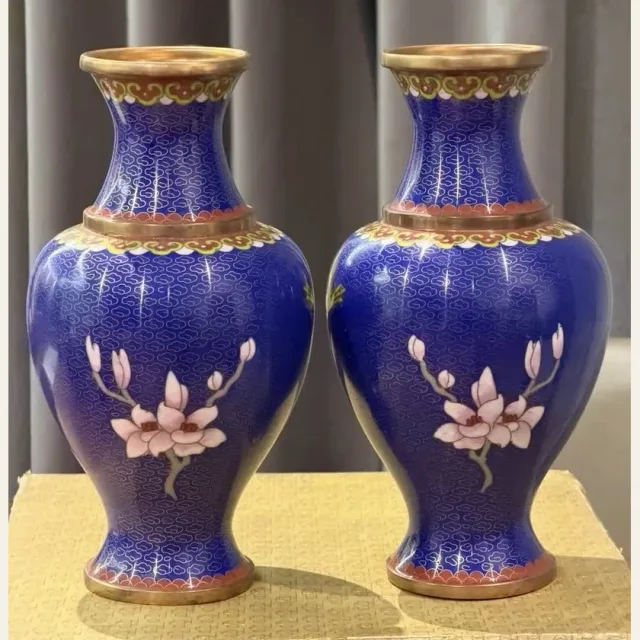
On the other side of the pair, a single pink flower has more blue space around it. Where a pink petal meets the blue ground, one line forms the edge of both colors. Farther up the belly, thin loops are visible within the blue itself. A partition can outline a shape even where the color stays the same on both sides.
What firing and finishing change
During firing, separate glass grains fuse into a more compact layer. The glass can settle below the tops of the strips, so makers may fill and fire the compartments again. Grinding and polishing bring the exposed edges and the glass to the desired finish. In some workshops, gilding adds a thin gold finish to exposed metal.
Sources: The Met · Chinese Cloisonné
Read the rim and shoulder from above
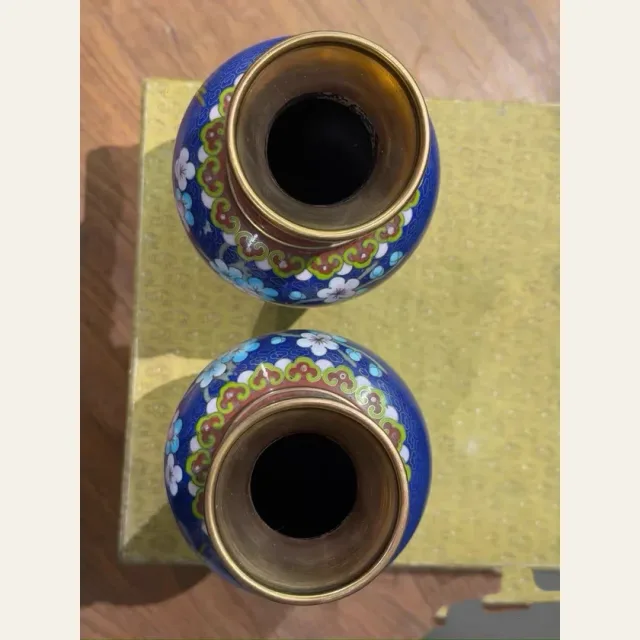
From above, the mouth rim forms a continuous ring. The shoulder border sits farther out, where fine lines separate the red and green motifs into smaller fields. The broad ring marks an edge of the vessel. The fine lines across the shoulder divide its decoration. A close view of the surface can show where those lines sit, while a maker’s or museum’s record can confirm how the piece was made.
Sources: The Met · Chinese Cloisonné