

What Is Hand Embroidery? How to Read the Stitches
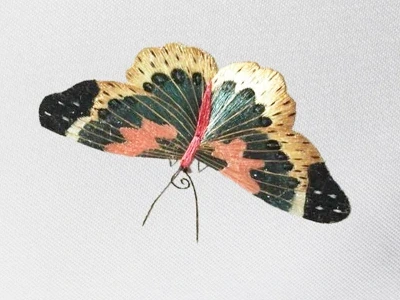
See how stitches form an edge on an embroidered butterfly and give a green leaf the appearance of a curl.
By BeenEast Editorial · Published · Reviewed
What is hand embroidery?
Hand embroidery uses a needle and thread to make a design on fabric. A stitch is the length of thread laid between the points where the needle passes through the cloth. Stitches can join end to end to draw a line or sit side by side to fill an area. The butterfly and leaf below show how those arrangements shape what you see.
What makes the edge of a wing?
The gold stitches along the top of the butterfly’s wings end at slightly different points. Their ends form the small curves you see against the pale cloth. Another way to make an edge is to stitch a line around the shape. In backstitch, the needle comes up a stitch length ahead, then goes back into the hole at the front of the previous stitch. The stitches meet end to end to make a continuous line.
Sources: Royal School of Needlework · Back stitch
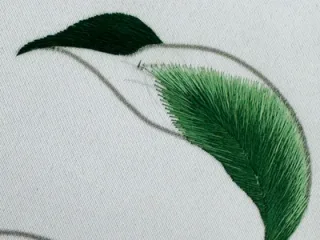
How stitches turn inside a leaf
In the partly stitched leaf, you can see individual stitch ends beside the bare cloth. On the broad green band, the stitches spread apart toward the outside of the curve and crowd closer together on the inside. That change in angle lets the filling follow the bend of the leaf.
Sources: BeenEast · Embroidered leaf study
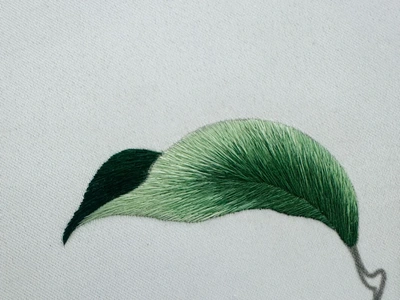
Once the leaf is filled, the pale green stitches curve around its middle. Near the pointed tip, the pale area meets a much darker green. The changing stitch angles lead your eye around the bend, and the sharp change in color makes the tip look as if it has folded over.
What an object record can tell you
A close-up can show where stitches turn and where colors meet. A maker’s notes or a museum record can also identify the fiber, technique, or place of production when those details are documented. The V&A’s illustrated guide introduces silk embroidery traditions such as Su embroidery from Jiangsu. A butterfly or leaf motif alone gives too little evidence to assign a piece to that tradition.
Try reading a single motif
On another embroidered motif, pick one edge and find where the thread meets the bare fabric. Then follow two or three stitches inside the shape. If their angles change, see where that change leads your eye. On the green leaf, it leads around the curve toward the dark tip.
Continue reading
References
V&A · Embroidery styles: an illustrated guide