

How do parallel satin stitches follow a round edge?
max ·
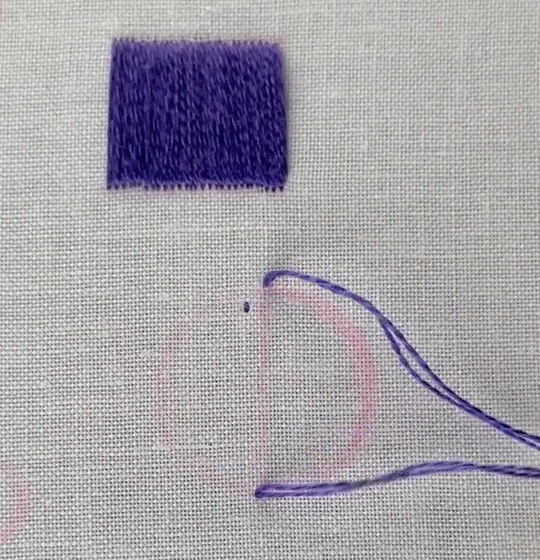
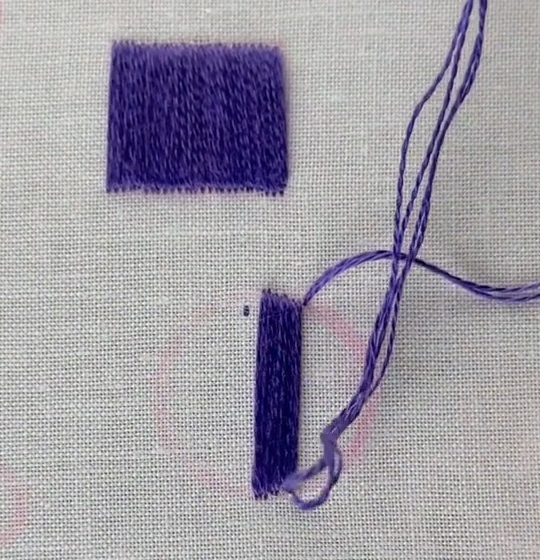
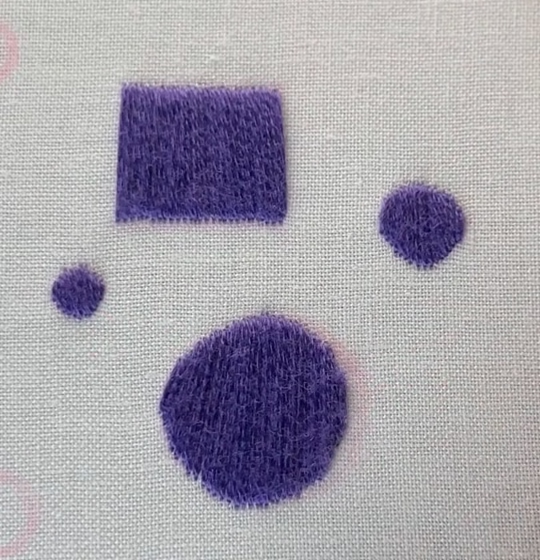
Parallel satin stitches can make a round edge by changing length as their endpoints follow the drawn curve. The individual stitches stay straight; the outline comes from where they enter the cloth. In these three views from one stitching demonstration, a purple square sits above a circle being filled on pale woven fabric. The square gives a useful comparison: its opposite edges remain roughly the same distance apart, while the circle narrows toward its sides.
Read the settled stitches, not the loose loop
In the first photo, loose working thread crosses the pink circle guide below the filled square. Do not read that loose loop as the finished shape. In the second photo, a narrow band of purple stitches has built up inside the circle. Follow the settled stitches from their upper ends to their lower ends, then compare both ends with the pink curve. The thread still rising above the cloth belongs to the stitch in progress; it cannot show the final tension of the whole fill.
Compare the round edge with the square
The later overview shows several filled practice shapes on the same cloth, including a large purple circle below the square. The large circle has a broadly upright stitch direction. Its curved boundary is formed by the changing positions of the stitch ends, rather than by bending each stitch around the rim. This final view also contains smaller round samples; the three photos do not document the complete stitching sequence for each one.
Trace both ends before filling a gap
Use the linked satin-stitch guide for a small leaf exercise that applies the same endpoint check. At a visible gap, follow the neighboring stitches to both edges before adding more thread: one misplaced end can leave a wedge of cloth exposed. At a notch, compare the endpoint with the marked outline. Keep neighboring stitches side by side, without stacking one on another. The guide also asks you to check the cloth after releasing the hoop. These photos support an observation about shape and stitch placement, not a measurement of the sample size, thread count, hidden outline, or reverse-side finish.
Related resource
 Embroidery
Inspiration and guides on embroidery.
Explore Embroidery